
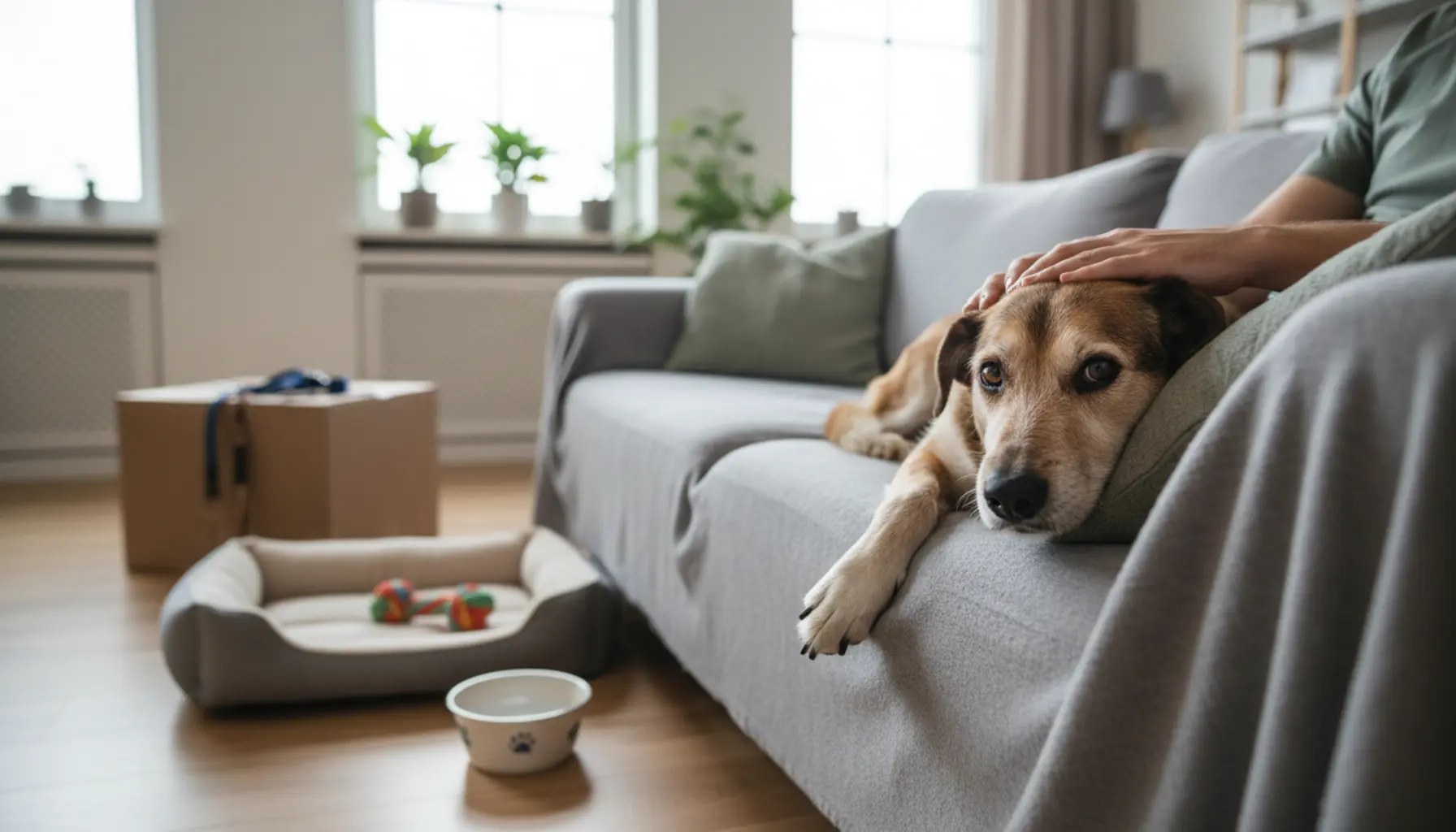
Adoption and care for a dog with a traumatic past is a unique challenge. The key is to provide the animal with safety, predictability, and gentle emotional support. Discover proven ways to build trust in a traumatized dog, as well as the most common mistakes to avoid.
Table of Contents
- Why Does a Dog with a Difficult Past Need Special Care?
- Preparing Your Home for an Adopted Dog
- The First Days with a Dog after Trauma: How to Foster Calm
- The Role of a Behaviorist in Adapting a Dog with a Difficult Past
- Creating Daily Routines for Safety and Comfort
- Which Mistakes to Avoid When Introducing a Dog to a New Environment
Why Does a Dog with a Difficult Past Need Special Care?
A dog with a traumatic past is not just an animal with a tough history, but above all a being whose nervous system has long functioned in “survival mode.” Such dogs often have experienced abuse, neglect, life in fear, isolation, extreme sensory deprivation or, conversely, overwhelming stress and chaos. All of this leaves traces in their behavior, emotions, and physical health. From a behavioral perspective, many situations that are neutral or even enjoyable to the average dog (a city walk, human touch, the presence of other dogs, the sound of a vacuum, sudden movements of children) may be perceived as real threats to a traumatized dog. Their nervous system is more sensitive to stimuli, quickly activating the “fight, flight, or freeze” response, and difficult past experiences form strong associations — often completely illogical from a human perspective. That’s why special care is not a “caprice” but a necessity: it helps the animal gradually emerge from a constant state of alarm, rebuild trust in people and the world, and learn to function in a safe, predictable routine. Without this, a dog may be stuck in a web of fear for years, reacting with aggression, withdrawal, or over-excitement even to the smallest triggers. Furthermore, chronic stress and past trauma often result in real health problems: weakened immunity, digestive issues, muscle tension, sleep disorders, or even self-harm through excessive licking of paws or tail. Caring for a dog with a traumatic past must cover both emotional and physical spheres, combining psychological comfort with regular veterinary diagnostics and cooperation with a behaviorist or trainer. Importantly, just because a dog has ended up in a “better life” does not mean it will immediately feel safe. Often, the opposite is true: new surroundings, new smells, different rules, and unfamiliar people can be overwhelming. It takes time, repetitive rituals, and clear, gentle rules for the dog’s brain to associate the new place with safety, not yet another unexpected change.
Special care for a dog with a difficult past also stems from the fact that its “baggage of experiences” affects how it learns and reacts. Many of these dogs not only suffered trauma but also missed key socialization periods — they never experienced the world of humans, city sounds, car rides, vet visits, or gentle human touch. This means they start from a very different point than dogs raised in stable, caring homes. Standard upbringing and training methods that work well for a “typical” young dog may be insufficient or even harmful for a traumatized animal. Too fast a training pace, intense exercises with many stimuli, lack of emotional breaks, or ignoring subtle stress signals (turning the head, licking lips, yawning, tensing up) can only deepen the dog’s fears. That’s why an individual approach is crucial: gradual exposure to new situations, implementing simple, predictable daily routines, fostering the dog’s sense of control (e.g., by allowing it a safe place that is never disturbed), and consistent but gentle boundaries. Dogs with a traumatic past often respond differently to stimuli — some are apathetic and withdrawn, others hyperreactive and constantly “on guard”; yet others freeze and then suddenly explode behaviorally. Understanding that fear—not “stubbornness” or “disobedience”—is behind these responses is essential. Such a dog needs a caregiver who reads its body language, respects boundaries, doesn’t punish fear, but helps regulate it. Special care also means consciously managing the environment—reducing excess stimuli at home, providing a safe corner, fixed meal times, walks, and rest periods. For a traumatized dog, routine is like a map making the world predictable. With kind consistency, patience, and specialist support, the dog may eventually not only stop fearing but also discover that human contact, play, learning new skills, and calm walks can actually be joyful. But for this to happen, careful, attentive care that accounts for history and trauma limitations is crucial.
Preparing Your Home for an Adopted Dog
Preparing your home for a dog with a difficult past is best started by seeing the space from the dog’s perspective — as an animal that may be hypersensitive, distrustful of people, and carrying negative associations with seemingly mundane situations. Before the dog enters, establish clear family rules: where the dog may go, who is responsible for walks, feeding, training, and how to respond to fearful or aggressive behaviors. Consistency and predictability are the foundations of safety for a traumatized dog, so everyone in the home should know not to shout, physically punish, surprise with sudden movements, or force contact if the dog withdraws. Let children and guests know that for the first weeks, “quiet mode” is in effect—minimal noise, no sudden visits, avoiding crowds. In terms of space, the main priority is to designate a “safe zone” — a quiet, undisturbed place where the dog can hide and rest with no constant stimulation. This could be a covered crate (if the dog has no negative association with being enclosed), a bed in the corner, or for especially anxious dogs even a separate room. It is important that no one “invades” the dog’s zone — it should be a place where only the dog initiates contact, and children must understand it is off-limits. Provide a soft bed, access to water, and possibly a scent mat or chews to help the dog relax. Safety-proof the house: secure cables, remove poisonous plants and chemicals within nose reach, hide shoes, clothing, and small items that could be swallowed. Dogs with traumatic pasts often relieve tension by chewing, destroying, or compulsive licking, so minimize temptations and potential dangers. Ensure there’s no way for the dog to jump from windows or get stuck on balconies—a fearful or startled dog can panic and “flee” even if it seemed calm before. Consider an “acoustic buffer”—add curtains, carpets, or white noise/soft music to mask outside noise; many traumatized dogs are highly sensitive to sudden loud sounds like fireworks, sirens, shouting, or slamming doors.
Besides the home setup, it’s crucial to establish a routine that is clear to the dog from day one. Plan fixed times for meals, walks, rest, and play, and design a gentle “welcome ritual”—a calm greeting with no crowd, no looming over or hugging, no forced petting. It’s better for the first day to be “boring” and predictable than full of excitement; overstimulation may cause a traumatized dog to shut down, try to escape, or react aggressively out of fear. When assembling supplies, in addition to essentials like bowls, a leash, a collar or harness, consider accessories for emotion regulation: long, safe natural chews (dried skins, hard treats), scent mats, lick toys (like a lickmat), or treat-dispensing balls—these engage the nose and brain rather than hype up the dog physically. For many traumatized dogs, sniffing activities are emotionally safer than running or tug-of-war. Consult with a behaviorist or trainer who uses positive methods — send information (history, past issues, shelter or rescue reports, videos) before adoption to have a plan and know what to watch for. The behaviorist can advise if you need extra gates, a crate, a bed in another room, and how to introduce the dog to family, other animals, and new stimuli. If there are cats or other dogs, arrange logistics: separate spaces at first, controlled “distance introductions” (over a gate or cracked door), and separate bowls, beds, and a litter box for the cat to minimize conflict. Prepare documents and contacts: before the dog arrives, note the number of a trusted vet and behaviorist, and set up a spot for medical records, vaccination cards, blood test results. Have a well-fitted “escape-proof” harness, especially if the dog has tried to escape or has panic outdoors—many escapes happen in the first days after adoption. Careful home prep, a calm atmosphere, and a clear routine will lower your new dog’s stress, laying the foundation for trust, bonding, and safety.
The First Days with a Dog after Trauma: How to Foster Calm
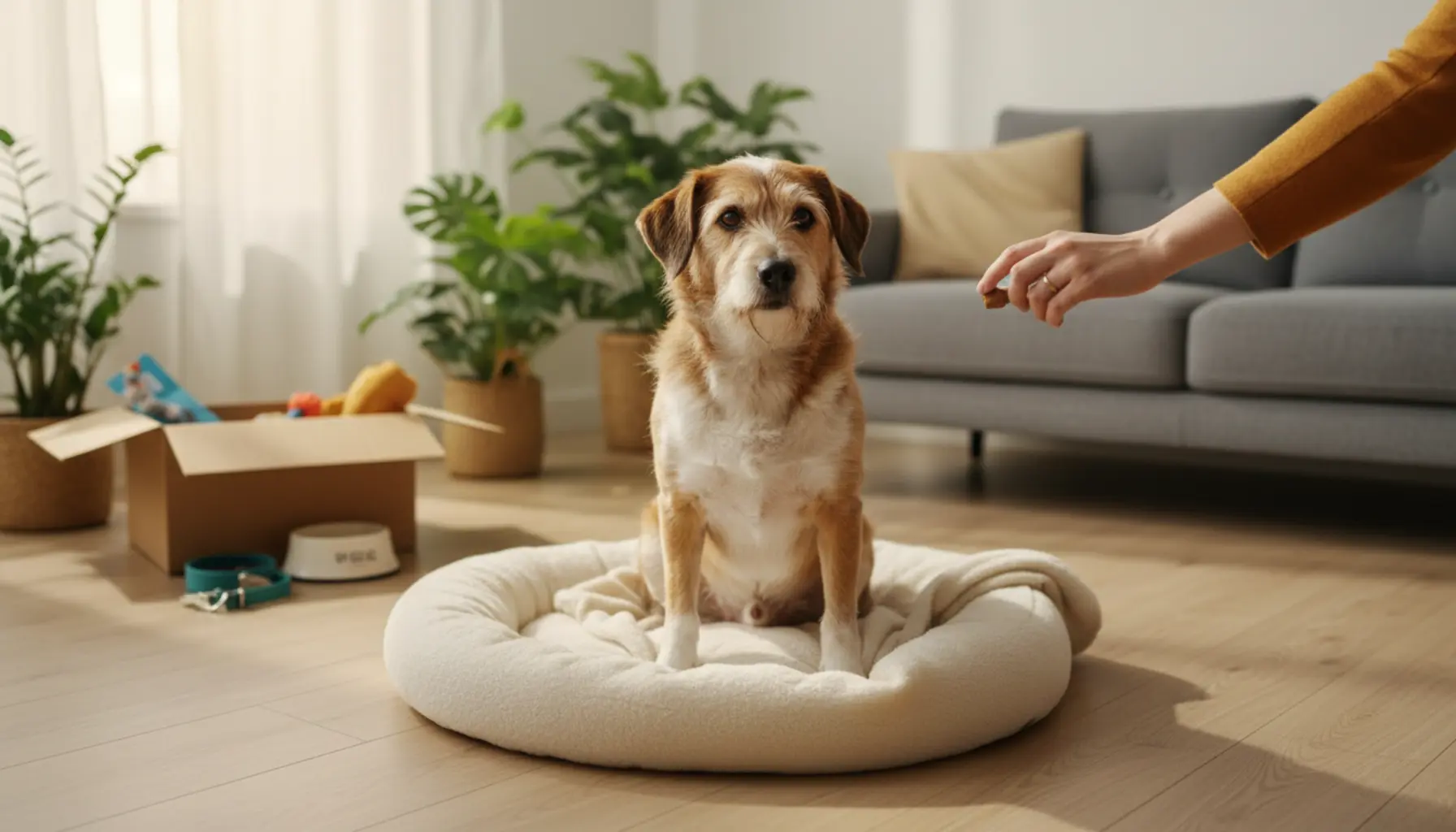
The first days after adopting a dog with a difficult past are critical for building a sense of safety and trust, so the priority should be minimizing stimuli and maintaining predictability. Instead of bombarding the dog with new impressions, use the “less is more” principle—fewer visitors, less noise, fewer changes. From the first moments at home, allow the dog to explore the space at its own pace, without forcing physical contact, petting, or play. A good practice is to kneel sideways to the dog, avoid direct eye contact, and let it choose to approach, sniff, or walk away. Create a calm atmosphere — turn off loud music, minimize children’s shouting, avoid sudden movements. Speak to the dog in a low, predictable tone, repeating the same short cues or signals (“let’s go”, “please”, “thank you”), helping the animal begin to associate your voice with calm and predictability. Establish simple rules for household members: no forced hugging, no “testing” the dog (like taking its bowl or toys), no physical or vocal punishment. Traumatised dogs are quick to react to tension, and any harsh behavior will reinforce the belief that the world is dangerous. Create appropriate rituals from the start: feed at the same times, take on short, calm walks with a set route, then provide rest in the “safe zone.” Limit stimuli outside—choose quiet walk hours, avoid crowded streets, playgrounds, and busy intersections. If the dog freezes, tries to flee, barks, or growls, do not punish—instead, increase the distance from the stressor, allow time for a break, and calmly redirect with a treat or lead to a safer spot. Watch the dog’s body language: nose licking, yawning, head turning, low posture, tail tucked—these are stress signals meaning the dog needs more space and time. Decide early on where the dog will sleep and nighttime routines. Some traumatized dogs struggle alone in the dark, barking, howling, or panicking. Rather than enforcing isolation, place the bed nearer your room or leave the door ajar, and provide gentle white noise (fan, air purifier) to mask sudden sounds outside. In the first days, postpone intense training and new commands—the goal is to build safety, not “obedience.” Gradually introduce rituals, like calmly sitting before a meal, a short “come” cue before entering, or gently guiding to the bed. Reward any desired behavior with treats, soft praise, or gentle petting if the dog accepts touch, but never demand physical contact before the dog is ready.
Managing your environment is vital for a traumatized dog’s calm—the fewer negative experiences, the better. Use gates to keep the dog out of overwhelming areas (busy hallways, windows to the street) or where it could get scared, knock things over, or get hurt. If you have kids, give clear instructions: don’t approach the dog while eating, drinking, lying down, or hiding; don’t shout or run near the dog; if you want contact, ask an adult to judge if the dog is ready. Mark the dog’s “calming zone” clearly—a bed, open crate, mat, or blanket in a quiet corner with the rule that no one disturbs the dog there. In these first days, help calm the dog further with natural chews (dried meat, dog-safe chews), scent mats, or treat-filled “Kong” toys—chewing and sniffing reduce tension and regulate emotions. Don’t overload the dog with attractions—one simple scent toy a day and quality rest is better than a “marathon of activities.” Observe how much the dog sleeps spontaneously—many traumatized dogs sleep little due to constant vigilance; support them through a regular day (fixed meals, walks, nighttime quiet), softer evening lighting, no guest visits or noisy entertainment. If the dog chooses “strange” sleep places (behind the sofa, under the table, in the corner), don’t force it to the bed—make that place safe and stimulus-free. In these first days, limit contact with strangers and animals—including eager family and friends. Each meeting is another load on the dog’s nervous system. Instead, focus on quiet coexistence: being together in one room, working on the computer while the dog naps nearby, moving calmly around the house. This kind of neutral companionship lays the groundwork for future deeper bonds and challenges, with support from a behaviorist who can individualize the pace of change to the dog’s needs and sensitivity.
The Role of a Behaviorist in Adapting a Dog with a Difficult Past
An animal behaviorist plays a key role in helping a traumatized dog adapt by viewing its behavior through the lens of emotions, life experiences, and the nervous system’s operation. Unlike a traditional “trainer” who often focuses mainly on command training, a behaviorist analyzes the roots of fear, aggression, or withdrawal, and then proposes a plan tailored to the individual dog and realistic household capabilities. The first step usually involves a detailed interview: the specialist collects information about the dog’s history, past problems, injuries, living conditions, nutrition, and daily routines. This helps identify which stimuli are especially overwhelming (noise, sudden movements, unfamiliar men, other dogs), and which situations may trigger panic or defensive behaviors. During the visit, the behaviorist observes the dog’s natural behaviors at home: movement, body tension, reactions to touch, interactions with family, and subtle signals like yawning, nose licking, or turning away. This allows for an assessment of stress levels, self-regulation skills, and the extent to which the current environment helps or hinders calmness.
Based on these observations, an individual behavioral therapy plan is developed—not to “fix the dog,” but to reduce tension, rebuild a sense of safety, and create behavioral strategies comfortable for both dog and people. With traumatized dogs, a behaviorist often starts with the basics: instituting a predictable daily routine, ensuring sleep quality, suitable nutrition, and modifying the environment (barriers, gates, hideaways, scent mats) so the dog can choose to withdraw from stimuli. Next comes teaching the owner to spot calming and stress signals so they can intervene before “explosions” like growling, snapping, or leash pulling. The behaviorist offers specific guidance: how to greet the dog, how and when to pet (or not), how to organize walks to avoid overstimulation, and how to gradually acclimate to new situations. Positive reinforcement techniques and giving the dog control are stressed—scent work, simple tasks, learning cues that help the dog calmly opt out of challenging situations. Behaviorists often cooperate with vets; for deeply traumatized dogs, it’s crucial to rule out pain, neurological issues, or hormonal imbalances that might fuel fear or aggression. Sometimes, when the nervous system is chronically overstimulated, a vet and behaviorist may consider pharmacological support (e.g., anti-anxiety meds), always paired with environmental therapy and training. The behaviorist’s role also includes educating owners on managing relationships with people and animals—advising when and how to introduce social contact, how to minimize misunderstandings (e.g., asking strangers not to pet the dog), and how to respond in crises when the dog “freezes” or reacts suddenly. This specialist acts as a guide and “translator of dog language”: helping families understand that what seems like “stubbornness” or “dominance” are actually fear-coping strategies, and that change requires time, consistency, and enormous patience. Thanks to regular consultations, behaviorists can continually update the plan, monitor progress, warn against pushing the dog too fast, and support owners during setbacks or new forms of anxiety. Such long-term cooperation significantly increases the chance that a traumatized dog will not only adapt but learn to live calmly, predictably, and safely with the entire family.
Creating Daily Routines for Safety and Comfort
For dogs with a difficult past, predictability isn’t a “nice extra,” it’s the foundation of well-being. Their nervous system often remains in “alert mode,” so a clear, repetitive daily structure gradually signals that the environment is safe and stable. Begin creating routine with three pillars: fixed meal times, walks, and rest periods. Ideally, these activities should occur at roughly the same times every day—the dog will soon anticipate what comes next, lowering stress. For many traumatized dogs, how each task is performed is just as important: a calm voice, no rush, familiar rituals around the food bowl, harness put on in the same order, the same spot in the room where you call your dog—these details become a stable framework reading “everything is normal.” Practically, arrange a “day’s skeleton”: morning outing and meal, break for quiet, one or two simple exercises, calm evening walk, and “end of day” ritual (scent game, gentle petting if the dog wants it). Remember, the goal is not to “fill the day” intensively, but to set predictable blocks of activity interspersed with plenty of rest. Traumatized dogs get overstimulated easily, so daily routine should be simpler and calmer than for a confident dog. Adopters often try to make up for a tough past with many attractions, outings, or new experiences, but from the dog’s perspective, this is too much—consistency and gentleness are far more important than “entertainment” or excitement. Use simple verbal “announcements,” like always saying the same phrase before putting on the harness or serving food—the dog learns to associate words with events, easing anxiety about unexpected human actions.
It’s very important to weave into the daily plan small, steady rituals for calming and emotion regulation. A dog with a difficult past needs not only exercise but, above all, activities that help “come down emotionally”: sniffing during walks, licking scent mats or chews, calm chewing of appropriate treats, simple self-control exercises (like “wait” before exiting) done with zero pressure. Many can be worked into otherwise routine moments—waiting at the door before a walk, a quick scent game before a meal, a chew time after a stressful outing. Avoid overdoing training; a few daily micro-rituals repeated consistently are safer than rare, long, exhausting sessions. Maintain flexibility: routine doesn’t mean a “to-the-minute” schedule, but a predictable sequence and type of activities. If your dog has a rough day (bad weather, extra anxieties), shorten the walk but keep its structure (same direction, gentle start, favorite sniffing spot). As stress levels drop, gradually—always cautiously—introduce new challenges, one by one, always observing the dog’s reactions. Routine becomes the “safety base,” a place the dog can step out from and return to as needed. Adjust your schedule to individual needs—some do best with longer, calm walks, others need several short outings; some require more daytime sleep, others prefer regular, gentle interaction. Observe when your dog seems most relaxed (looser muscles, soft face, slow breathing) versus when anxiety or reactivity spikes. Use this to tweak your plan, minimize overload triggers, and strengthen what fosters calm. A well-composed, repetitive daily structure is one of the most effective and cost-free “therapeutic tools” for traumatized dogs—requiring above all consistency and mindfulness from humans, yet giving the dog priceless predictability and a sense of control over their own life.
Which Mistakes to Avoid When Introducing a Dog to a New Environment
Introducing a traumatized dog to a new home is a point where, even with good intentions, mistakes are easily made, significantly delaying adaptation. One of the most common is too rapid a pace: many new owners try to “make up for” the dog’s life of suffering by flooding it with stimuli, attractions, visitors, long walks in crowded places, or intense training in the first days. For a dog whose nervous system is unregulated, this overload is overwhelming and can result in withdrawal, apathy, or aggressive fear-based behaviors. Another major mistake is inconsistency in house rules: family members react differently to signals, sometimes allowing the dog on the couch, other times scolding. Traumatised dogs handle unpredictability very poorly—chaos increases their anxiety, as they can’t understand what is expected. Excessive coddling is also a problem: trying to “make up for the past” by, for example, hugging every time the dog is scared rather than modeling adaptive reactions with calm leadership. Another common mistake is ignoring subtle stress behaviors—yawning, nose licking, tense posture, turning away, or “freezing” are dismissed, with caregivers continuing interaction, hugging, petting, or provoking contact with children or strangers. Over time, dogs learn that subtle signals are ignored and may resort to “clearer” communication like growling or snapping. Another well-intentioned slip is exposing the dog too early to crowded places: shopping malls, restaurants, dog parks, city centers at rush hour. The owner wants to show the dog “normal life” but actually bombards it with noise, smells, and sudden triggers the animal can’t yet handle. Another common problem is lacking a truly secure sanctuary at home—the bed is placed in a busy area, by the front door, or in a central spot with constant traffic, cleaning, or loud conversation. A dog lacking a place to “disappear” cannot learn to self-regulate emotions, and tension may remain high all day. Using punishment (especially physical or shouting) to “teach rules” is another major mistake—for a traumatized dog, these methods instantly recall old trauma, destroy newly forming trust, and fuel the belief that humans are unpredictable and dangerous. Even “soft” aversive corrections (leash jerks, shaking, stern scolding) are overwhelming for many sensitive dogs and lead to freezing or defensive escalation. Overlooking the dog’s health is another pitfall: assuming “that’s just how he is” instead of consulting a vet and behaviorist may cause pain, illness, or tense muscles to be misinterpreted as “difficult temperament,” delaying therapy and increasing frustration. Be wary of demanding “ideal behavior” too quickly—expecting a dog to walk on a loose leash, stay alone for hours, accept strangers, or tolerate touch in all situations from the start is a recipe for failure. A dog that doesn’t yet trust people cannot meet unrealistic expectations, and each “failure” breeds owner anger or disappointment, which the dog senses perfectly. Failing to consult a specialist at the right time is another serious error—many wait for problems to “pass on their own,” but solidified separation anxiety, fear aggression, or compulsive behavior only get more entrenched; early intervention and professional help often prevent worsening problems and channel the dog’s energy into safe, predictable routines.
Summary
Adopting a dog with a traumatic background is a challenge that requires commitment, understanding, and patience. The key step is creating a safe environment and introducing fixed routines to help the dog feel comfortable. It is important to provide peace in the first days and allow for gradual adaptation. Seeking advice from a behaviorist can help resolve behavioral issues. Avoiding sudden changes and respecting the dog’s personal space will foster a sense of security. Adopting a traumatized dog can be immensely rewarding if approached with heart and prudence.

