

Clumber Spaniel is a unique spaniel breed, distinguished by its calm temperament, solid build, gentle character, and moderate requirements. Discover its history, appearance description, grooming tips, health issues, and the real costs of maintaining this elite dog.
Discover the Clumber Spaniel breed: character, appearance, grooming, health, price, and tips for future owners. Find out if this is the right dog for you!
Table of Contents
- Clumber Spaniel – origin and breed history
- Appearance and distinguishing characteristics of the Clumber Spaniel
- Temperament and character of the Clumber Spaniel
- Grooming and health requirements
- Clumber Spaniel as a family and hunting dog
- Price, maintenance costs, and useful tips for future owners
Clumber Spaniel – origin and breed history
The Clumber Spaniel is one of the oldest but least known retrieving and hunting dog breeds deriving from Great Britain. Its history is tinged with legend, but most cynologists agree that the breed’s beginnings date back to the 18th century and are closely associated with the aristocratic style of hunting. According to the most popular version, the ancestors of Clumber Spaniels arrived in England from France, most likely from the Pyrenees region. It is said that a French aristocrat, Duke de Noailles, faced with the French Revolution, handed over his best hunting dogs to a friendly English aristocracy to save them from confiscation or destruction. These animals ended up at the court of the Duke of Newcastle and his estate, Clumber Park in Nottinghamshire – hence the breed name “Clumber Spaniel.” Although not all sources confirm this romantic story, it is consistently repeated in cynological literature and is deeply rooted in breed tradition. However, it is certain that at Clumber Park – vast, wooded hunting grounds – selective breeding was undertaken to produce the ideal companion for quiet hunting in dense undergrowth. The ancestors of the Clumber Spaniel are believed to have been various field spaniels, now-extinct local hunting dogs, and possibly – according to some theories – the Basset Hound or even the St. Bernard, which would explain the heavier build and characteristic, slightly “weighty” expression of this breed. From the very beginning, the Clumber Spaniel was created as a dog working close to humans, slow but very persistent, able to quietly penetrate brush, point and flush game (mainly partridges and pheasants), and then retrieve the shot prey – often in difficult, wet terrain. Already in the 18th and 19th centuries, Clumber Spaniels were highly valued by the British aristocracy, favorites of lords hunting birds, and frequently appeared in paintings and engravings as a typical element of idyllic, hunting landscapes. A special role in the breed’s development was played by the family of the Dukes of Newcastle, who maintained and improved their breeding lines for generations, treating these dogs almost like family heritage. Over time Clumber Spaniels also won recognition at the royal court – it is known that both Queen Victoria and King Edward VII owned dogs of this breed, which further consolidated their prestige.
The formal breeding history of the Clumber Spaniel is closely connected with the emergence of the first kennel clubs and purebred dog shows. The breed was officially presented at one of the first dog shows in England as early as 1859, and when The Kennel Club was founded in 1873, the Clumber Spaniel was among the breeds quickly recognized and cataloged. At that time, pedigrees started to be recorded, a breed standard was established, and consistency of type was maintained. From the 19th century up to the early 20th century, the Clumber Spaniel was primarily a working dog, only later becoming popular as a companion dog – though always maintaining a strong hunting instinct. Over the years, the breed’s silhouette has changed slightly: the dogs became a bit heavier and more massive, mainly due to breeding focused on show qualities. Nevertheless, in Great Britain and countries with strong hunting traditions, there are still working lines of Clumber Spaniels, which are lighter and more fit. On the European continent and in Poland, the breed remains rare, only recently gaining interest among those seeking a calm, balanced spaniel with a less “sporty” temperament than the popular Cocker or Springer. The Clumber Spaniel has been recognized by the FCI (International Cynological Federation) and classified in Group 8 – retrievers, flushing dogs and water dogs, Section 2: flushing dogs, underlining its original purpose as a bird-flushing and field working dog. Although today it is more often found on the couch than in forest thickets, its hunting history is still evident in its movement, powerful yet compact body, strong nose, and extraordinary sense of smell. The long tradition of working alongside humans has also left its mark on the breed’s character – attachment to the owner, focus on tasks, and a calm, balanced nature are traits that directly result from its historical role. Nowadays, the Clumber Spaniel is considered relatively rare and elite, and responsible breeders try to combine the old working type with modern health and welfare standards. While the era of great hunts in estates like Clumber Park is mostly history, today’s Clumbers still carry the heritage of aristocratic hunting – and it is precisely this historical background that makes them so unique among other spaniels.
Appearance and distinguishing characteristics of the Clumber Spaniel
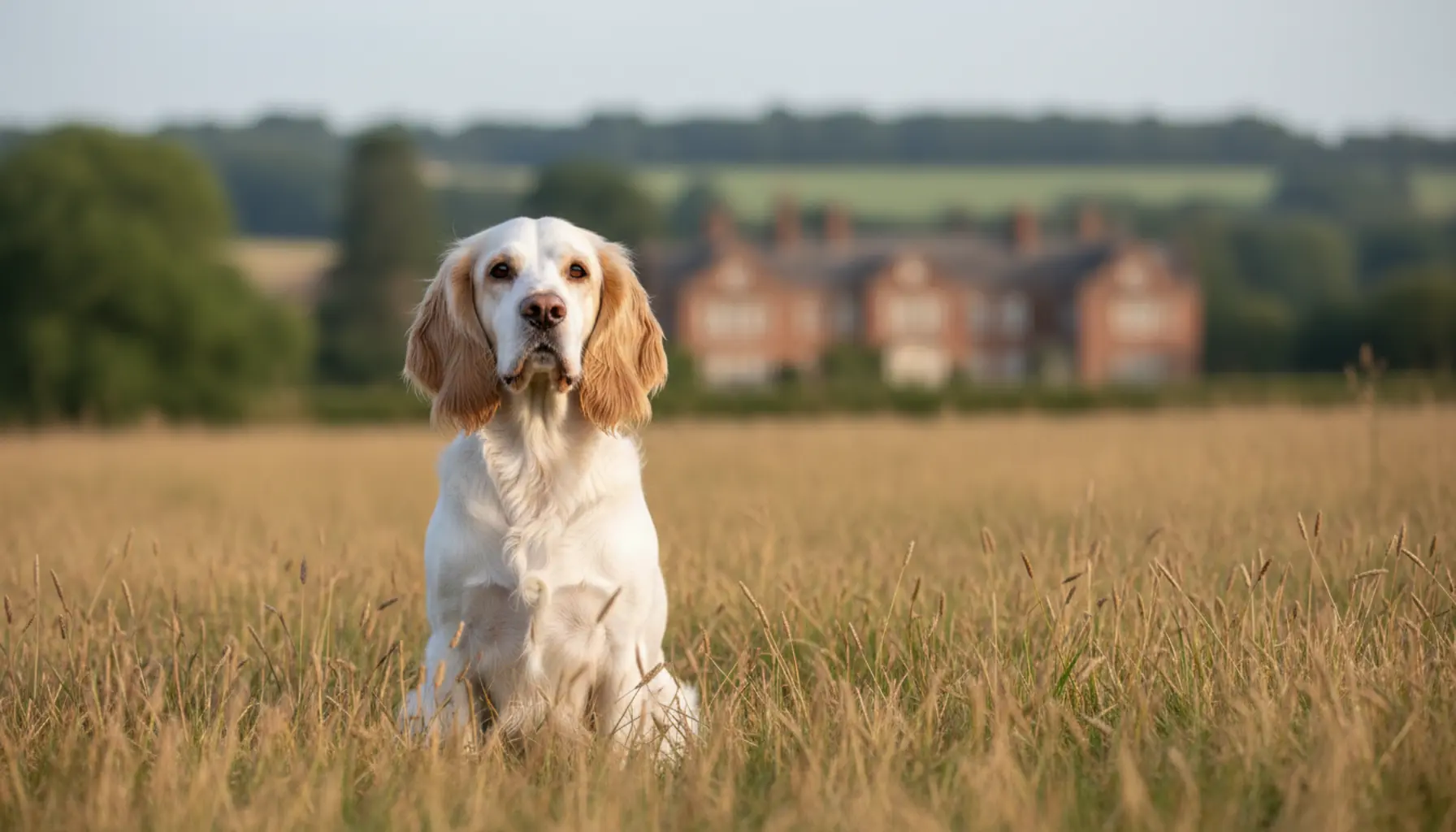
The Clumber Spaniel is immediately recognizable among other spaniels by its massive, elongated build and calm, somewhat phlegmatic demeanor. It is the largest of the British spaniels – a strong, heavy dog with a powerful bone structure, but without clumsiness in movement. Adult dogs typically weigh 25–34 kg, bitches are slightly lighter, and the height at the withers is about 43–51 cm. The silhouette is rectangular, slightly elongated, with a broad, deep chest and a well-muscled rear. The back is straight, the loin strong, which together with the broad chest creates the impression of a “low, solid tank” – such build is not accidental, as it allows the dog to move efficiently through dense undergrowth and difficult terrain, for which it was originally intended. The limbs are shorter than those of many other hunting breeds, but very strong, with clearly defined joints and deep paws with thick pads, which improve traction in mud or wet grass. The tail, traditionally docked in some countries, is most often left natural in Poland and according to modern FCI guidelines – it is of medium length, set at the level of the back, well-feathered, carried level with or slightly below the back, and moves cheerfully from side to side, giving the dog a cheerful, “wagging” appearance.
However, the most characteristic feature is the Clumber Spaniel’s head: large, heavy, broad, with a pronounced stop and a long muzzle. The forehead is broad and flat, with slight wrinkles that deepen when the dog is focused or tired. The eyes are almond-shaped, medium-sized, slightly sunken, in dark or light brown color, giving the dog a typical gentle and somewhat melancholy expression. Many people see calmness, intelligence, and patience in the Clumber’s gaze – “the eyes of a philosopher,” as breed enthusiasts often say. The eyelids may have a slight tendency to droop, but should not excessively expose the conjunctiva; well-selected breeding lines minimize this risk. The ears are large, vine-leaf shaped, set low, fitting closely to the cheeks, with gently rounded ends and soft fur, often slightly feathered. The muzzle is strong, rectangular, with a broad nose, usually brown or dark pink-pigmented; lips are well developed but not excessively pendulous, which limits drooling compared to typically molosser breeds. The Clumber Spaniel’s coat is another hallmark – medium length, dense, straight or slightly wavy, with a soft texture, and a very abundant undercoat that protects the dog from cold, moisture, and brush. The hair is longest on the ears, chest, belly, the back of the limbs (so-called feathering), and under the tail, which gives the dog an elegant, “feathered” look, but also requires regular grooming. The breed standard allows only white coloration, with smaller or larger markings in orange or lemon shades, especially on the head, ears, and at the base of the tail; spots on the body are welcome but cannot completely dominate the white base. The Clumber’s skin is quite loose, which, combined with its massive body and abundant fur, may make the dog appear “softly” contoured – though underneath that coat is a strong, durable body capable of hours of fieldwork. In movement, the Clumber walks smoothly, with an even, efficient stride, good rear drive, and a distinct forward reach of the forelegs, unhurried but very persistent. Despite its seemingly phlegmatic appearance, it is an athletic dog, adapted for slow but continuous searching of terrain, which also reflects in its daily demeanor – a dignified, calm, yet always ready companion, whose appearance perfectly represents its working role and balanced character.
Temperament and character of the Clumber Spaniel
The Clumber Spaniel is a dog with an exceptionally balanced, calm, and somewhat phlegmatic disposition, which distinguishes it from many other more lively spaniels. In the home, it often seems like a “sofa sloth” – it enjoys long naps, being near its human, and life in a steady rhythm, free of excess noise and chaos. At the same time, despite this apparent sluggishness, it is still a hunting dog: when it senses an interesting smell, its tracker instinct switches on, calmness gives way to focus, perseverance, and surprisingly agile movement. Clumber Spaniels form deep attachments to their owners, are extremely loyal, and often choose a single “favorite” person in the family whom they follow everywhere. They are naturally gentle, affectionate, and delicate, do not tend to be aggressive, and thus do well as family dogs, even in homes with children. Their attitude toward the youngest is even caring – they allow cuddling, willingly participate in gentle play, but due to their mass and somewhat clumsy movement in tight spaces, adult supervision is required to avoid accidentally knocking over a child. With strangers, the Clumber is usually reserved, distant but not fearful – it needs a moment to accept a new person, after which it often initiates contact itself, demanding petting and attention. This is not a noisy or excessively barking dog; it usually barks only for a specific reason, and thus is a good, though rather subtle “signaler” of a stranger’s presence. The absence of violent reactions, stable emotions, and resistance to stimuli make the Clumber adapt well to city life, provided it gets enough walks and opportunities to explore the surroundings with its nose. With other dogs, it tends to be calm and polite, usually avoids conflict and chooses withdrawal over confrontation, though a male may dispute with another dominant dog if provoked. The hunting instinct is present, but oriented mainly toward birds, so not every Clumber will have a strong urge to chase cats – much depends on individual predispositions and early socialization. An important element of the breed’s character is its tremendous sensitivity to the owner’s mood: the dog quickly “reads” emotions, responds to the tone of voice and household atmosphere, making it an empathetic companion, but it does not cope well with yelling, tension, and inconsistency in upbringing.
Despite its calm nature and intelligence, the Clumber Spaniel can be stubborn and independent, and its motivation can be highly selective – it is happy to cooperate when it sees a point and a clear benefit (praise, treat, shared play), but with unclear rules or monotonous training, it may seem “deaf” to commands. It is the classic “special task dog”: during hunting or tracking, it impresses with concentration, accuracy, perseverance, and eagerness to work with the handler, whereas in everyday obedience, it may show slight nonchalance. For this reason, it is recommended for patient, calm, and consistent people who do not expect the dog to immediately and unquestioningly follow commands, but rather a partnership based on positive reinforcement. The Clumber does not tolerate harsh tones, violence, or excessive pressure – it may “close in on itself,” refuse cooperation, or even develop fearful behaviors. In the right hands, however, it is an excellent and stable companion dog: it is not prone to hyperactivity, usually behaves calmly when left alone at home (provided it has had prior exercise and mental stimulation), does not excessively destroy objects, and its need for closeness is shown more by lying at the owner’s feet than demanding constant attention. The breed has a discreet, introvert’s charm – it doesn’t need to be the center of attention, nor does it impose itself on guests, but once it loves someone, its loyalty is boundless. Thanks to its relatively low reactivity and predictable behavior, it is often recommended for people seeking a gentle family dog, but who are also ready to accept a certain degree of stubbornness, independence, and the “peculiar sense of humor” of the breed. It is also worth noting that young Clumbers can be much more lively and boisterous than adults – adolescence takes time, and mental maturity often only comes around age three. Appropriate socialization from puppyhood, contact with various people, dogs, and environments, and patient introduction of house rules are key to fully developing the calm, balanced, cheerful character for which the breed has been appreciated for generations by hunters and families alike looking for a faithful, gentle companion for years.
Grooming and health requirements
Although not among the most demanding breeds in terms of grooming, the Clumber Spaniel requires regular and mindful care to maintain good physical and mental condition. Its coat is medium-length and dense, with a lush undercoat that provides protection in tough terrain, but also encourages matting and dirt accumulation. Coat care primarily comes down to regular brushing – at least 2–3 times per week, and every day during shedding periods. The best tools are slicker brushes and metal combs, used to thoroughly detangle the ear area, groin, tail, and “pants” on the hind legs, where the coat mats most easily. It is also advisable to regularly trim excess hair between and around paw pads for the dog’s comfort, hygiene, and to reduce slippage in the home. Baths do not need to be frequent – usually every few months or whenever the dog is visibly dirty. For bathing, use gentle shampoos for dogs with light coats and conditioners to ease detangling. The Clumber Spaniel also has delicate skin, so excessive washing or aggressive cosmetics can lead to irritation and itching. Ear care is extremely important in this breed – ears are large, heavy, and hang closely, which limits air flow and encourages yeast and bacterial growth. Ears should be checked weekly and cleaned with special dog ear cleaners if needed; never insert cotton swabs deeply into the ear canal. Do not ignore warning signs such as foul odor, redness, head shaking, or scratching – these may indicate inflammation. Additionally, eye hygiene is important, as Clumbers have somewhat deep-set eyes: it’s worth wiping the corners of the eyes daily with a damp gauze pad, especially if discharge appears. Regular nail trimming every few weeks, if not worn down naturally, is a standard part of care, as is regular tooth brushing or the use of products that reduce tartar formation. Due to a tendency to gain weight, the Clumber Spaniel’s diet should be carefully balanced – high-quality food, tailored to age, activity level, and any health issues. Puppies and young dogs should not be overfed to avoid excessive stress on the rapidly growing skeletal system; adult Clumbers gain weight easily, so portions must be controlled and treats used wisely, ideally as rewards during training. Foods supporting joints (supplemented with glucosamine, chondroitin, omega-3 fatty acids) are advisable as protecting the musculoskeletal system is key. Physical activity should also be appropriately dosed: the Clumber isn’t a marathoner, but requires daily, calm walks (around 1.5–2 hours a day) combined with sniffing, retrieving, or mental exercises to avoid obesity and boredom.
Healthwise, the Clumber Spaniel is a relatively robust breed, but like most heavily built dogs, is prone to specific diseases future owners should be aware of. The most common issues are orthopedic disorders such as hip and elbow dysplasia; for this reason, it is crucial to choose puppies from kennels that do X-ray testing of parents and do not breed individuals with severe disorders. Young Clumbers should not be overly burdened – climbing stairs, intensive running alongside bikes, or long training sessions on hard surfaces are inadvisable at least until 12–18 months when their joints and bones are more developed. Another issue is eye diseases, such as entropion (inward rolling eyelid), ectropion (outward rolling eyelid), cataracts, or dry eye syndrome. Regular eye exams, especially in breeding dogs, help detect problems early and prevent complications, including vision loss. The breed is also predisposed to ear disease (chronic inflammation), hence, in addition to daily grooming, periodic vet checks are recommended for recurrent infections. Clumbers may also suffer from hypothyroidism, which manifests as lethargy, weight gain, skin issues, and coat deterioration – in such cases, hormonal testing and treatment are necessary. Owing to their massive build and deep chest, there is a risk of gastric torsion, especially after large single meals and vigorous exercise just after eating. To minimize this risk, split daily food into 2–3 smaller meals, avoid physical activity right after eating, and watch the dog for alarming symptoms (abdominal pain, excessive salivation, retching, restlessness). The Clumber Spaniel generally lives 10–12 years, and their lifespan and comfort depend largely on preventive health care: regular vaccinations, deworming, protection against ticks and fleas, and regular check-ups – once a year for young dogs, at least twice a year for seniors. Older Clumbers require special care for joints and heart, modified diet (lower calorie content but richer in nutrients for aging dogs), and gentler activity. Early identification of pain symptoms (reluctance to move, stiffness after rest, change in gait) and consultation with a vet allow the introduction of pain relief, physiotherapy, or supplementation, helping the dog remain mobile and content for longer. Good prevention, sensible nutrition, and appropriate exercise are the foundation of Clumber Spaniel health and key to minimizing most breed-typical problems.
Clumber Spaniel as a family and hunting dog
The Clumber Spaniel combines the traits of a family and working dog in a very specific way – a calm, affectionate homebody who at the same time has never lost its original hunting instincts. In daily family life, it is distinguished by composure and a gentle approach to household members, which makes it adapt well both to homes with children and those with elderly people. Its “phlegmatic” nature is often deceptive – at home it does indeed love lounging on the sofa or in its bed, but on walks or in the field, it can switch to work mode, constantly with its head to the ground, tracking scents. As a family dog, the Clumber isn’t the energetic type requiring extreme activities, but it does need regular, moderate exercise – longer walks, opportunities for free sniffing, and calm games with the owner. In relation to children, it is usually patient and tolerant, willingly accepting caresses and closeness, but as with any breed, children must be taught proper handling (no pulling ears or tail, no disturbing during meals or rest). Because of its stable character, Clumbers respond well to a predictable, orderly routine – fixed meal, walk, and rest times help them feel safe. At home, they are rarely noisy, not excessive barkers, though they can bark to signal the presence of a stranger; however, they are not typical guard dogs and should not be taught as such. A well-socialized Clumber usually greets guests calmly, loses interest after a short introduction, and returns to its favorite spot. In relations with other household pets, such as cats or other dogs, they often prove surprisingly tolerant and gentle, provided they were exposed to a variety of species and situations from a young age. Their natural retrieving instinct makes them enjoy carrying things in their mouths – toys, tugs, or even their owner’s slippers; this trait is worth utilizing by teaching the dog simple tasks at home, which satisfies its need for work and strengthens the family bond. Unlike many more lively spaniels, the Clumber is relatively “invisible” in an apartment, but this does not mean it will tolerate long hours of solitude well – extended absence of human contact may lead to boredom, frustration, and even destructive behaviors such as chewing objects or compulsively licking its paws. Therefore, the ideal home for a Clumber is one where someone spends at least part of the day at home, providing companionship, calm walks, and simple mental activities.
At the same time, the Clumber Spaniel remains a fully-fledged hunting dog, created to work in the field, woods, and wetlands, as evidenced by its behavior, endurance, and way of moving in challenging terrain. As a hunting dog, it belongs to the flushing and retrieving group – its task is to search for, flush, and retrieve small game, mainly birds. Unlike more excitable Springer or Cocker Spaniels, the Clumber works at a slower pace but very methodically, nose always near the ground, thoroughly checking every bush and brush. Hunters value this trait for hunts in dense, difficult cover where a calm, consistent, and durable dog is needed rather than an “energy explosion” bolting without control. Its moderate temperament makes the Clumber work well with a hunter who knows how to motivate and set clear expectations – the Clumber is not a “remotely-controlled” dog but a partner who needs motivation and clear work rules. Even if you do not plan to hunt, hunting instincts will still be present: on walks, it can intensely sniff, attempt to track birds or small animals, and in the forest, loves to poke into bushes to “investigate.” Therefore, it is important to establish recall and use a long training leash before allowing off-leash runs. For non-hunting owners, there are great alternatives in sports and activities imitating fieldwork – e.g., dummy training (retrieve with special dummies), utility tracking, mantrailing, or nosework. Clumbers usually excel at scent tasks requiring calm, focus, and meticulousness rather than explosive speed. For the dog, this is an excellent way to use mental and physical energy, and for the owner – a chance to utilize its natural talents in a controlled, safe setting. However, developing hunting instincts comes with a price: the dog may become even more fascinated by scents in the field, so obedience training, including reliable recall and work on focus in distractions, should go hand-in-hand with utility training. In hunting families, the Clumber superbly combines both roles – working in the field during the season, retrieving and tracking, then quickly switching to its calm, couch-potato mode at home, happily sleeping at its owner’s feet. This adaptability to different environments is seen as one of the breed’s greatest assets, provided both its need for human companionship and for work and exercise are respected daily.
Price, maintenance costs, and useful tips for future owners
The Clumber Spaniel remains a very rare breed, which directly affects its price and puppy availability. In Poland, litters appear sporadically, so a prospective owner should expect to reserve and wait for a puppy. The price of a Clumber Spaniel from a legal, FCI-registered kennel usually starts at around 8–10,000 PLN, and for puppies with outstanding pedigrees and titled parents, it can reach 12–15,000 PLN or more, especially when the breeder invests in genetic testing, shows, and working training. Lower prices offered by puppy mills should be a red flag – savings at the start often result in high treatment costs, behavioral problems, and no support from the “breeder.” When choosing a litter, look at the parents’ test results for hip and elbow dysplasia, eye diseases, and their general mental and living condition. The initial costs are not only the puppy itself but also its layette: bed, crate or pen, bowls, leash and harness or collar, chew and interactive toys, grooming products (brushes, combs, ear and eye cleaners), and the first food. In total, it’s best to have about 1,000–2,000 PLN for the start, depending on product quality and what equipment you already have at home. Also include the costs of the first vet visits – vaccinations, deworming, microchipping (if not done by the breeder), and making a passport if you plan to travel abroad.
Maintaining a Clumber Spaniel on a monthly basis is more expensive than with small breeds, but comparable to other medium and larger dogs. High-quality balanced food costs about 200–350 PLN a month, depending on composition, brand, and whether you choose dry food, wet food, or a mixed or BARF diet (for the latter, add supplement costs). Due to its tendency toward obesity and joint problems, saving on food is a false economy – proper diet is a real investment in the dog’s health. Add to this regular preventive vet visits: annual vaccinations, check-ups, deworming, medications against ticks and fleas, and possible blood or joint X-rays in adolescence/adulthood. Annually, expect around 800–1,500 PLN for preventive care, excluding emergencies or illness treatment. Grooming a Clumber, though possible on your own, requires tools and supplies (several hundred PLN per year), and some owners opt for professional grooming – each session is usually 150–250 PLN or more, every few months. Include also training and socialization costs: puppy classes or basic obedience courses cost 600–1,200 PLN for group cycles, bringing enormous benefits for daily life. An additional, often overlooked expense, is health or accident insurance – for a breed prone to orthopedic issues, this may be a sensible long-term budget safeguard; premiums usually range from a few hundred PLN a year, depending on coverage. Before deciding on a Clumber Spaniel, honestly analyze your lifestyle and finances: this dog needs time, attention and regular funds, but not necessarily a highly active, sporty routine. Key tips for future owners include: regular, moderate exercise instead of sudden strenuous effort (especially during growth), consistent weight monitoring with controlled portion sizes and avoiding “feeding from the table,” calm, patient training using positive methods, early socialization with people, children, other dogs, and various environments, and gradually accustoming the puppy to grooming from a young age. Good practice is to prepare household rules before the dog arrives (places where the dog can rest, walk routines, rules for being alone), and to organize a safe, quiet rest area away from excessive stimulation. Choose a breeder who gladly answers questions, allows visits, shows adult dogs, shares health results, and does not release puppies “on a whim” to anyone. A responsible breeder is the first and often most important source of breed knowledge and support for new owners, which is of particular importance for rare and demanding breeds like the Clumber Spaniel.
Summary
The Clumber Spaniel is an extraordinary breed with a gentle character, solid build, and outstanding hunting and companionship skills. Thanks to a harmonious combination of temperament and intelligence, it performs excellently as both a family dog and an active companion for fieldwork or outdoor activities. It requires regular grooming and proper health care, but its devotion and friendly nature make all the effort worthwhile. Choosing a Clumber Spaniel means gaining not just a wonderful friend but also a reliable daily life companion.

