
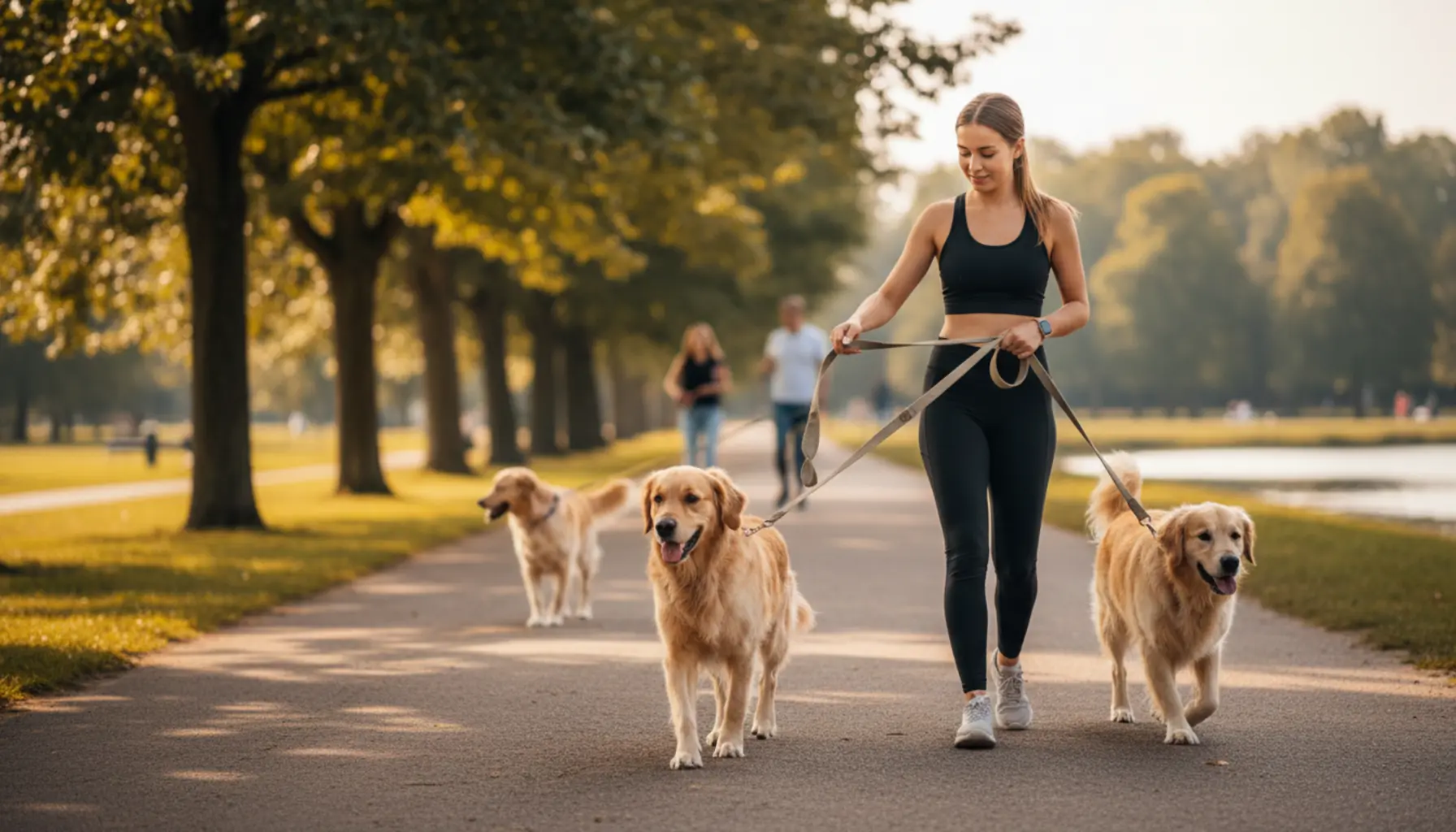
Do you want to enjoy peaceful walks with your dog, but your pet keeps pulling on the leash? Learn step by step how to teach your dog to walk on a loose leash, discover the most common mistakes, and proven techniques to make every walk a pleasure.
Table of contents
- Three Simple Steps to a Loose Leash
- Learning to Walk on a Leash: Practical Advice
- The Most Common Mistakes and How to Avoid Them
- The Importance of a Loose Leash for Dogs
- Professional Courses and Training
- Benefits of Walks Without Tugging
Three Simple Steps to a Loose Leash
The easiest way to think about teaching your dog to walk on a loose leash is as a simple three-stage plan: setting clear rules, building the habit in controlled conditions, and gradually moving these skills into the “real world.” The first step is to create clear boundaries for your dog: one rule, one word, one method of leading. Decide on which side your dog should walk, what the correct position looks like (e.g., the dog’s shoulder aligned with your leg), which reward word you’ll use (“good”, “super”), and which command signals the start (“let’s go”) and the stop (“stop”). It’s important to stick consistently to these commands and routines—if sometimes you allow pulling, other times you expect perfect walking, you send mixed messages. Also, immediately introduce a clear distinction between “working” and “sniffing time”: you might use two types of walks or a cue like “free/release”, after which your dog can wander away on a longer leash and explore, but until the release cue, the rule is a loose leash and no tension. In this step, also prepare the right equipment: a regular, several-meter leash (not retractable), a well-fitted collar or guard harness, and attractively varied treats (everyday and highly enticing, like soft bites). The way you hold the leash is also part of the rules—instead of wrapping it several times around your hand, hold it short but relaxed, giving your dog at least 1–1.5 meters of slack so there’s room to move but not enough to get up to pulling speed. When the rules are clear and consistent, your dog will understand what you expect faster and associate that it’s a LOOSE leash—not taut— opening up the possibility for calm, comfortable walks.
The second step is to practice in the easiest, least distracting environment before going “to town.” Start at home, in a hallway, garden, or quiet stairwell—anywhere with few outside stimuli. Put the leash on your dog and simply take a few steps, carefully observing when the leash stays loose. These moments are your training gold: mark them with a verbal cue (“yes”, “good”) and instantly reward with a treat delivered near your leg at the position you want for the future. Don’t wait for a perfect, long stretch—at first, you’ll reward literally single steps on a loose leash. If your dog starts to get ahead and the leash gets tight, immediately stop, don’t jerk the leash, just stand still like a “lamp post.” Eventually, your dog will look back at you or return half a step—at that moment the leash becomes loose again, then you reward and give a command encouraging moving on. This way, step by step, your dog learns that a tight leash stops the walk, a loose leash “turns on” movement and access to the environment. You can use a simple mini-drill: 5–10 steps forward, stop, turn, 5–10 steps back—the dog is rewarded every time it follows beside you with a relaxed leash. Once you can manage several dozen steps without pulling in a calm environment, move to the third step: gradually increasing difficulty. Don’t jump straight to busy streets—first add single distractions: a different sidewalk, a quiet street, a walk at another time of day. Apply the principle “the more distractions, the simpler the expectation”: if you’re passing a playground, don’t expect perfect eye contact—if the leash stays loose for a few steps, that’s already a success worth rewarding. You can use the “zigzag” technique—instead of walking straight (which encourages pulling), every several steps change direction: turn to the side, step back, walk the other way. This way, the dog stops “pulling forward” because it doesn’t know where you’ll go next, so it starts to pay more attention to your movements. Every direction change, preceded by a verbal signal (“this way”, “right”), teaches the dog that it pays off to stay close and monitor leash tension. Gradually lengthen walking segments, reduce reward frequency, but offer “environmental rewards”: if the leash stayed loose for a few meters, let your dog go sniff on cue (“free”). This way, you build a clear three-step scheme in practice: clear rules, practice in easy conditions, gradual transfer to increasingly challenging spaces, where the loose leash becomes the ticket to everything your dog finds most attractive.
Learning to Walk on a Leash: Practical Advice
Teaching a dog to walk on a loose leash begins with proper preparation—both for the dog and the owner. First, make sure you have suitable equipment: a well-fitted, comfortable collar or (preferably guard-type, non-restrictive) harness, and a simple non-retractable leash 2–3 meters long. Retractable leashes reinforce pulling, as the dog learns that to move forward, it must tighten the line. At home or in the yard, get your dog used to wearing the harness and having the leash attached—reward quietly with treats for allowing you to put it on and for not biting at it. Establish a clear start cue, e.g., “let’s go,” which will signal the beginning of the walk, and a consistent way of holding the leash: one hand close to your body and slightly bent, the other can manage the length, but avoid constantly shortening or tightening it. Before heading into stimulating environments, discharge excess dog energy with a short sniffing session at home, some tug play, or basic obedience exercises—a dog already “wound up” will be much harder to control on the sidewalk. During early trainings, adopt the principle that your dog must mainly learn what pays off: walking with a loose leash means freedom to explore, tension means stopping and no progress. A practical method is the “tree technique”: as soon as the leash gets tight, stop completely, stand still, don’t reel your dog in, no corrections—just wait. When the dog relaxes for a second, looks back or slackens the leash, calmly praise (“good,” “super”) and resume walking. You teach your dog that its behavior determines if the walk “flows” or “freezes.” Another useful exercise is the “direction change” method: walk straight, the dog pulls ahead, leash gets tight—then gently, without warning, turn another way. When the dog rejoins you and the leash loosens again, reward with a treat or praise. Several unpredictable direction changes in a safe area (like an empty lot or large yard) will make your dog pay closer attention to your position rather than barreling ahead blindly. It’s also important to rhythmically reward “being by your side”—initially, you can give a treat every 2–3 steps for walking by your leg without pulling. Keep treats in a pouch on your dog’s side and deliver them low at your thigh to reinforce the correct position instead of stretching forward. If your dog isn’t food-motivated, use toys (tug, ball on a string) as breaks—few steps with a loose leash, short play, then more steps. The more attractive rewards you carry, the easier it is to compete with environmental distractions.
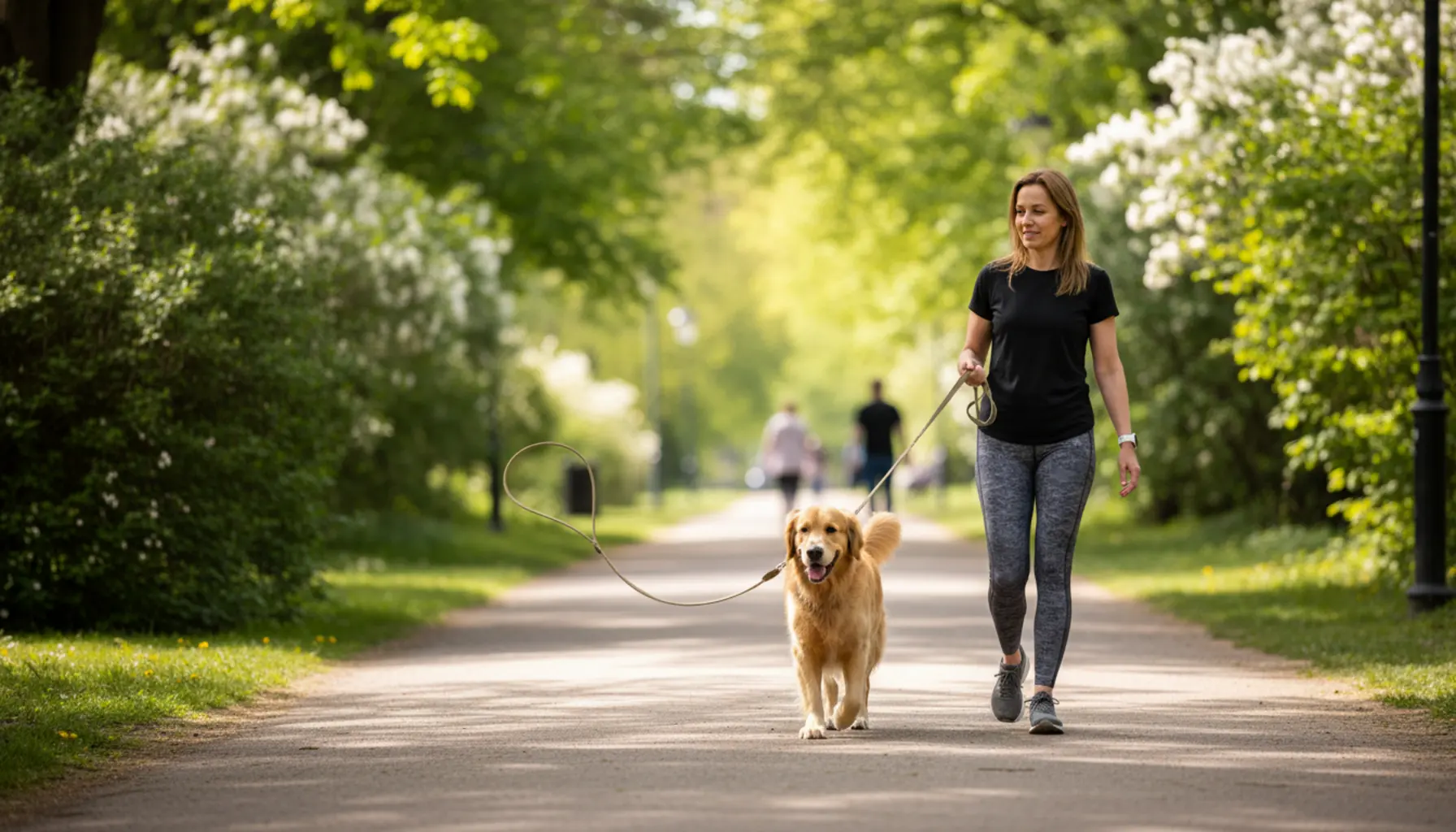
In the practical training of walking on a leash, responding to distractions—“life out in the field”—is crucial: other dogs, people, bikes, scents. Instead of hoping your dog will “grow out of it,” have a set strategy in advance. At first, choose quieter routes where you can control the distance to hard distractions. When you see something sure to excite your dog (like running children, a passing scooter), try a few brief focus exercises: prompt eye contact (“look”), reward twice, take a few steps by your leg, and reward every moment when—despite distraction—the leash stays loose. If your dog is too excited to take treats, you’re too close to the distraction—move away until your dog is able to learn again. Another practical technique is so-called “environmental rewards”: if your dog keeps pulling to sniff a bush, make it part of the training. Stop when the leash becomes tense, wait for it to slacken (or for brief eye contact), mark with a word (“good”, “ok”) and only then allow access to the bush. This way your dog learns it reaches interesting spots by calm behavior and a loose leash—not by pulling. Consistency is key—if you sometimes let your dog “win by pulling”, it will return to this pattern at every next bush. Practice will also bring issues like jumping, leash tangling or biting it during walks. In such cases, briefly “end the game”: stop, ask for a simple command your dog knows, such as “sit” or “come.” When completed, calmly praise and reward, and only then move on. If your dog chews the leash, avoid pulling back, which only increases excitement; instead, swap it for a toy or treat, and keep the leash as neutral as possible. Systematic practice is more important than the length of any single walk: it’s better to do three short, conscious outings of 10–15 minutes with lots of loose leash drills than one long walk where you let your dog pull “because it needs to run.” Eventually, gradually lengthen the stretches where your dog maintains a loose leash, and reduce food rewards, swapping for praise and environmental rewards. Most importantly: on daily walks, don’t return to old habits “because you’re in a hurry”—even if pressed for time, keep the principle: tight leash = stop, loose leash = we move on.
The Most Common Mistakes and How to Avoid Them
When teaching loose leash walking, most owners repeat the same patterns that unconsciously reinforce pulling instead of reducing it. One of the most common mistakes is letting the dog “sometimes” pull: when rushed, if it’s cold, raining, or when the dog “needs to burn energy.” For the dog, that’s a clear message—sometimes pulling works, so it’s worth trying every time. To avoid this, accept that the first weeks of training will be slower, and consistency is more important than walk length—if the leash tightens, you always stop, no exceptions. Another mistake is starting training too late and in conditions that are too difficult. The owner immediately heads for a busy street, a dog-filled park, or blocks during rush hour and expects focus the dog has never practiced before. The solution is increasing difficulty gradually: first, practice at home and in the stairwell, then a quiet lot, side alley, and only then popular routes. Another problem is chaotic communication: changing commands (“come”, “let’s go”, “move”, “hurry up”) and reactions—sometimes dragging forward, sometimes jerking sideways, sometimes stopping, sometimes ignoring the pulling. The dog has no way to understand the rules. Focus on one or at most two commands (e.g., “let’s go” and “stop”) and one clear rule: tight leash = stop, loose leash = walk, always. Another mistake is over-relying on corrective gear—prong collars, choke chains, so-called “no-pull” harnesses relying on discomfort. Such tools may briefly reduce pulling but don’t teach the dog what it should do; they can also cause pain, muscle tension, or associate walks with unpleasant experiences. Instead, go for comfortable, well-fitting Y harnesses or classic collars and a non-retractable leash, and base behavior change on clear rules and rewards. Many owners also ignore their dog’s motivation: if the dog pulls to get to a scent, another dog, or puddle, and the owner only fights with force, ignoring what rewards the dog, the training will frustrate both. Instead, use “environmental rewards” in training: reaching a bush the dog wants to sniff can reward a few steps on a loose leash—but only if there’s no pulling. Dropping food rewards too quickly is also a risk: let your dog learn gradually to stick close and monitor leash tension, especially in difficult settings. Move slowly from frequent food rewards to rarer ones, with more praise, games, or access to explore, rather than suddenly stopping all rewards.
Another common mistake is punishing the dog for something the owner just reinforced. A typical scenario: a dog pulls toward another dog, the owner lets it get close for a greeting, then, as the dog gets more excited and the leash tightens, suddenly jerks and yells. For the dog, the message is inconsistent—just a moment ago, pulling worked, now there’s a sudden unpleasant consequence. To avoid this, always apply the rule: the dog only gets what it wants with a loose leash. If the dog wants to greet another dog, it should approach only when it can briefly keep its excitement low enough that the leash remains slack. Another mistake is increasing emotional tension through one’s own behavior—hurried departures, nervous yanking, shouting, arguing with your dog. Dogs are highly attuned to our moods: the more stressed you are, the more your dog may respond with tension, pulling, and seeking an outlet for frustration. Instead, establish a calm walking ritual: a few seconds of focus exercises before leaving home, waiting for the loose leash at the door, calm “let’s go” command, then out. Many owners also overlook their dog’s physical needs—expecting perfect leash walking from a dog with “energy bombs” unused through movement or mental stimulation. Such a dog pulls simply because it has no other outlet for tension. The answer is to combine leash training with sufficient exercise (as much as possible on a long line or off-leash in secure areas) and nosework or mental tasks. Another issue is waiting too long for a “miracle breakthrough”: some owners train consistently for a week, but if after a few days the dog still tests pulling, they declare the method “doesn’t work” and revert to old routines or aversive gear. Remember that pulling may have been reinforced for months or years; several weeks of systematic training is normal, not a failure. Watch for small progress—does your dog loosen the leash faster after stopping, disengage from distractions more easily, are the first minutes of the walk calmer now? A common mistake is only training on one route—just under the block or only in quiet parks—then expecting automatic transfer to a city center or busy dog park. Dogs learn very contextually; to avoid disappointment, plan minimal environmental changes first (another street, but similar traffic), then add distractions gradually (more people, bikes, dogs). Likewise, assuming a dog “should know” loose leash walking just because it’s adult or “smart” uses labels instead of analyzing what exact skills are trained. Instead of being upset that “he knows it, just ignores me,” treat every pull as information: here it’s still hard, take a step back, increase support (e.g., return to a higher reward level), and only then raise the bar again.
The Importance of a Loose Leash for Dogs
A loose leash means much more to a dog than simply a more comfortable way to walk next to its owner—it’s chiefly about physical comfort, safety, and being able to interact freely with environmental stimuli. When the leash is tight, your dog’s body is under continuous, even if slight, muscle tension. With collars, this means pressure on the neck, larynx, and cervical spine; with harnesses—on the shoulders and chest. Ongoing pulling can cause joint strain, micro-injuries, cervical issues, or in some dogs even persistent coughing or discomfort when breathing. A loose leash lets your dog maintain a natural posture, freely move its shoulders, turn its head, and regulate stride length, making walks physiologically healthy instead of exhausting. For young, growing dogs, or older ones with joint issues, this matters even more—every sudden jerk can cause pain, which can quickly become associated with the presence of other dogs, cars, or people, leading to negative associations. In practice, a loose leash means a calm body, less excessive excitement, and being able to keep an even pace suited to the dog’s real ability, not dictated by tension between dog and handler. For dog communication and emotions, a loose leash also means a greater ability to express body language. A tight leash stiffens the posture, raises the head, tilts the body forward—often imitating readiness for confrontation. Other dogs often interpret this as a challenge or threat—leading to misunderstandings during encounters on narrow sidewalks or in parks. Conversely, a loose leash lets your dog move in a relaxed, rounded way, freely turn its body, curve its path around another dog, and send calming signals—from looking away, licking lips, to steady sniffing. Such communication freedom reduces the risk of conflict and tense social interactions, so the dog feels safer and generally less stressed. For many dogs, a loose leash is a tool allowing them to keep a natural repertoire of social behaviors, rather than being forced into the role of the “troublemaker” or “nervous” dog simply because the leash tension makes it impossible to express intentions gracefully.
From a dog’s mental perspective, a loose leash is also a clear sign that the owner is in control and doesn’t require the animal to always “push forward” to reach a goal. When dogs learn that only calm walking with their human means progress, they start to regard their owner as a predictable partner worth focusing on. This directly strengthens the bond: a dog that doesn’t fight leash tension can direct more attention to observing you, responding to your signals, and syncing to your pace. The loose leash becomes a “framework” in which the dog can safely explore—sniff bushes, circle around puddles, and notice passing bikes without needing to rush after them. The dog learns that self-control and connecting with its handler grants it access to what’s interesting: new smells, paths, lawns, or a chance to greet another dog. This dependency—self-control = environmental reward—builds a sense of agency and simultaneously reduces the frustration caused by the leash’s inherent limitation. Instead of seeing the leash as an obstacle, the dog starts to treat it as a “lifeline,” feeling secure and knowing what to expect. Additionally, a loose leash encourages efficient sniffing, which is one of the most important ways dogs regulate emotions—calm scent tracking reduces cortisol and helps the dog release tension, just as calm walking or meditation does for people. If the leash is tight, the dog moves quickly, erratically, jumping from one stimulus to the next, with no time for deep scent analysis, increasing arousal. Such walks return the dog home physically tired but mentally still “wound up.” A loose leash, allowing rhythmic sniffing at a relaxed pace, gives your dog a real chance for a restorative walk, after which it can settle down. This affects home life: dogs that fulfill natural needs and move freely on a loose leash are less likely to be hyperactive, destructively chew items, or demand attention persistently. In the long run, a loose leash is not just about comfort on walks, but a key element of the dog’s psychological, physical, and social well-being, building trust in people and the environment.
Professional Courses and Training
Professional loose leash walking courses can be a great support for owners who don’t see satisfactory results despite their efforts or simply want to speed up the learning process. An experienced trainer can assess not just the owner’s technique but also the dog’s emotional state, motivation, and previous experiences with people and leashes. This is especially important for fearful, reactive, rescued, or lifelong pullers. A well-led course doesn’t just repeat exercises in a group; above all, it tailors methods to the dog’s temperament and the owner’s physical abilities. The instructor can correct leash handling, harness/collar choice, walk pace, and propose a weekly training plan, turning chaotic attempts into a clear step-by-step process. Remember that courses vary in format: group lessons on a training field, individual outdoor consultations, or specialist programs for reactive dogs or “adolescent” dogs where pulling comes with other problems (like jumping on people, barking, or ignoring recall). A good specialist won’t promise “miracles in a week” but clearly states the amount of owner effort required and what realistic results you can expect with your dog.
When choosing training, pay attention to the trainer’s philosophy and chosen methods. Look for words like: positive training, reward-based methods, reinforcing desirable behavior, working with emotions, stepwise difficulty, and individual approach—and avoid offers based on “immediate obedience,” “dominance,” or “forceful correction.” A trainer teaching loose leash walking should primarily use rewards (treats, play, access to scents) and clear communication—not pain or fear. In practice, this means no prong collars, choke chains, or shock collars—instead, well-fitted harnesses and regular leashes. At the introductory meeting, ask specific questions: how does the trainer react if the dog pulls hard; what training tools are recommended; what does a sample lesson look like; is there time to explain the theory and home plan to the owner. It’s also vital for sessions to suit the dog’s level—if a beginner dog is trained in a crowded park from the start, it may be too stressed or overexcited to learn. A good course starts in calmer spots, then progresses to harder scenarios, lining up with the stepwise process described in at-home training. Modern schools often offer extra materials: instructional videos, written homework, online follow-ups, or brief post-training reports. This helps owners maintain the necessary regularity for results from class to transfer to daily walks. Also consider special-topic workshops—focused just on loose leash skills, concentration in the city, or calm passing of other dogs—since these intensively address the exact problem blocking comfortable walks.
Benefits of Walks Without Tugging
Loose leash walks mean much more than just “nice behavior”—they’re a real investment in your dog’s health, emotions, and relationship to the owner. Above all, no tugging protects your dog’s musculoskeletal system: no sudden overloads to neck, spine, shoulder and hip joints which, repeated over time, can cause micro-injuries, muscle tension, or chronic pain, stiffness, or resistance to movement. Dogs that constantly lean on the leash often compensate with an unnatural walking style, worsening pre-existing or exposing predispositions to orthopedic issues. Walking without pulling allows a freer, biomechanically correct stride, even weight distribution, and comfortable nosework with head lowered, safely without risking sudden neck yanks. As a result, your dog tires less, wears out slower, and exercise becomes truly regenerative rather than just effortful. There’s also a mental health benefit: a loose leash lowers general stimulation and stress, since the dog isn’t always “fighting” against restraint that only increases frustration. Constant leash tension prompts a “pull-tighten-frustrate-pull more” cycle, which in time can cause over-reactivity, barking, lunging at people or dogs. Walking loose leash means stimuli become “more bearable”: your dog can sniff, pause, curve away, and regulate emotions naturally as a dog should. This improves sleep and recovery—a calm walk means a more contented, relaxed dog at home, not one “wound up” and looking for release by destroying objects or barking excessively.
The benefits of walks without tugging are equally significant for the owner. Physically, they remove or greatly reduce shoulder, spine, and wrist strain, which can be considerable with a strong or energetic dog; over time, it’s easier to maintain proper posture and avoid “hanging back” on the leash or tensing up for fear of being yanked. Emotionally, calm outings lead to less shame, frustration or helplessness—instead of dreading your dog’s reaction in public, you can truly enjoy time together, plan longer routes, new places, and trips. There’s no constant need to monitor every step—once your dog understands loose leash rules, you can chat, check your phone, or observe your surroundings without worrying about being suddenly jerked to the side. The relationship between human and dog improves: rather than “tug-of-war,” you get partnership. Without conflict over the leash, dogs naturally check in, monitor your position, and seek your cues—because now the leash is a neutral part of the walking ritual instead of a signal of restraint. Owners can focus more on praising and reinforcing desired behavior, building mutual trust and security. In the long run, tug-free walks open doors to greater freedom: it’s easier to take your dog to town, vacations, friends, or outings wherever leashes are required. Well-behaved dogs are better accepted—people tolerate their presence, other dog owners are less worried, and you needn’t forfeit a richer life for fear of embarrassing incidents. Also, loose leash skills make other activities—like dog trekking, mountain trips, or seaside holidays—much easier, wherever leashes are a must but you want your dog calm and comfortable.
Summary
A loose leash isn’t just about walking comfort, but also about building a relationship with your dog. By following three simple steps and eliminating common mistakes, peaceful and harmonious walks are attainable. The importance of letting your dog walk freely impacts its mental health and raises the quality of your shared time. Professional courses and training can further support you in tougher situations, and the benefits of tug-free walks are evident for both dogs and their owners.

