
Nosework for dogs is an excellent way to develop their natural scent abilities. Regular nosework training at home strengthens the bond between the owner and the dog and provides essential mental activity. Discover the most important tips and accessories that will make nosework a safe and engaging activity.
Table of Contents
- What is Nosework?
- What Are the Benefits of Nosework for Your Dog?
- How to Start Nosework Training at Home?
- Choosing the Right Scents for Nosework
- Basic Accessories for Nosework Training
- Nosework: Tips for Beginners
Basic Accessories for Nosework Training
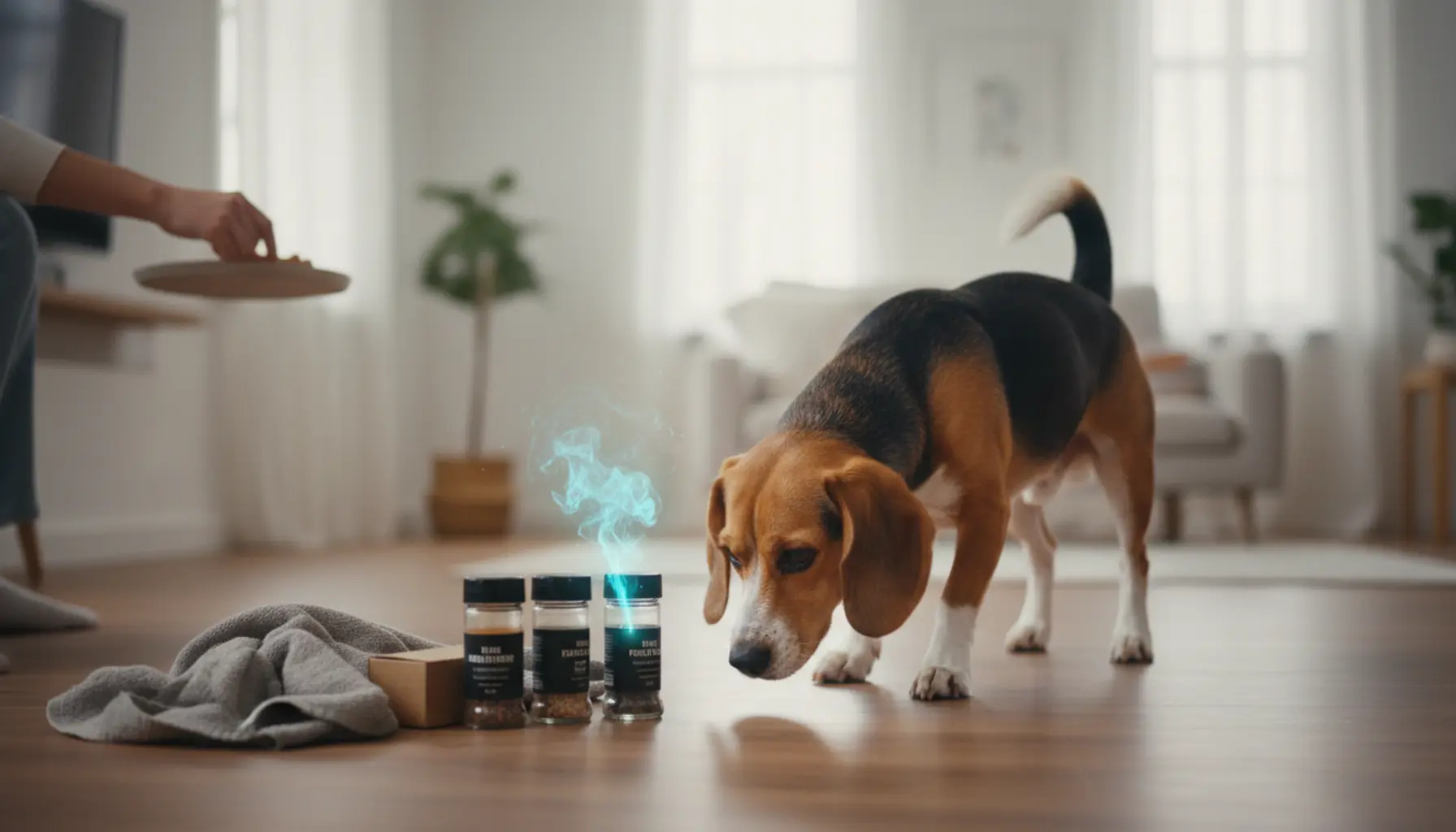
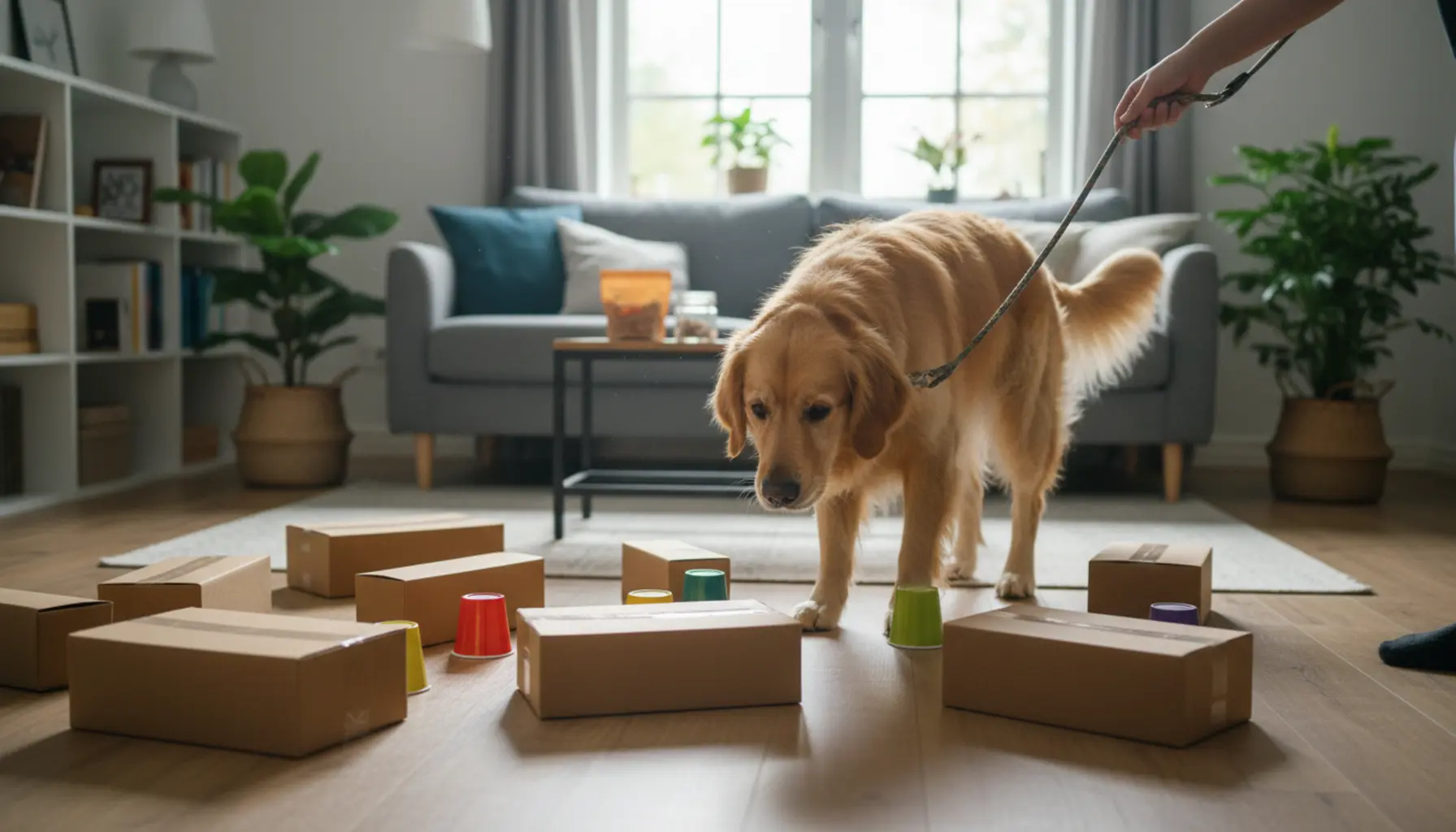
Although a handful of treats is enough for simple scent games, conscious nosework training is worth starting with a small but thoughtful set of accessories. The heart of this set is mainly the scent containers and holders – they determine how precisely the dog will learn to “read” the scent and how easily you can gradually increase the difficulty level. The most commonly used are small metal or plastic tins with holes (so-called tins), in which you place a cotton pad soaked with a drop of oil. Spice containers, tic-tac boxes, tea strainers, metal soap boxes, or mini DIY containers also work well – the key is that they are durable, have holes to let the scent through, and allow the scent holder to be hidden safely, ensuring the dog has no direct contact with the oil. It’s worth having a set of a dozen or so identical containers, which makes it easier to create more challenging scenarios later, e.g., when only one of many elements in the environment smells like the target. Equally important are the scent holders themselves: cotton pads, cosmetic swabs, small pieces of felt, or cotton wool; it’s best to assign specific types of holders to specific scents to keep the scent consistent and clean. There is a separate category for storage containers for scents and holders – airtight glass jars, well-sealed laboratory containers, or thick plastic boxes; each scent should have its own labeled container, stored away from the kitchen and food products. For safety, it is especially important to store essential oils in dark glass, out of reach of children and animals, in a cool and shaded place. For comfortable and repeatable training, different types of “hiding spots” are also useful: cardboard boxes of various sizes, plastic organizers, baskets, fabric bags, lunch boxes with holes, or even old shoes and clothing items. Cardboard boxes are cheap and easy to replace or modify – you can stack them in towers, lines, or mazes, giving you an almost unlimited number of configurations. At a later stage, try using more “everyday” hiding places, such as drawers, shoe boxes, fabric bags, and even furniture elements, so your dog learns to work in a real home environment. For your own comfort and training organization, it’s also good to have some simple helper tools: tweezers or small tongs for manipulating cotton pads, disposable gloves for working with oils (to avoid marking objects with your scent), duct tape or painter’s tape for attaching containers in less obvious places, and a marker for labeling containers and noting scenarios. This way you maintain control over which item is scented and which is neutral, which is crucial in more complex exercises later on.
The second pillar of well-organized training is accessories related to the safety and comfort of your dog. Nosework does not require specialist sports harnesses, but a comfortable, well-fitted harness and a longer leash (5–10 m) make work much easier, especially if you later want to move training from home to the garden, staircase, or a quiet parking lot. The leash allows you to accompany your dog during searches without restricting freedom or forcing them to walk at your side – in nosework, the dog is the “leader” while the human is a calm observer and supporter. High-quality rewards are also necessary: soft, aromatic treats in small pieces and – for dogs highly motivated by toys – a favorite toy on a string or ball intended solely for sniffing. It’s worth having a separate container or pouch for nosework treats, so your dog clearly associates the activity. To maintain order and consistency, a simple “trainer’s bag” or belt organizer – where you store all accessories: scent containers, spare pads, oils, treats, tape, tweezers, and a notebook for recording session progress – is very useful. Noting hiding places, difficulty level, and your dog’s reactions helps you quickly notice progress, planning errors, and your animal’s preferences (e.g., whether they work better close to the floor or at higher scent sources). As your dog’s skills develop, you can gradually expand the set with new elements: sniffing mats and blankets for “flat work,” plastic crates and shoe boxes, grids and strips to attach containers at various heights, and everyday items – umbrellas, chairs, drying racks, and boxes from household appliances. All this serves one purpose: to create a varied but controlled training environment where your dog can experience new challenges without feeling overwhelmed. It’s worth establishing “equipment hygiene” from the start: a separate box or case for nosework accessories, stored out of reach of your dog, regular checks of the condition of containers and locks, disposing of damaged or soaked containers, and clearly separating “food” equipment (for treat games) from “oil” equipment. Such consistency increases both safety and ease – and keeps the scents pure, clear, and predictable for your dog, resulting in faster learning, less frustration, and better training quality overall.
What is Nosework?
Nosework is a canine sport based on the dog’s natural ability to use its sense of smell, involving the search for specific scents in different environments. Unlike many traditional activities where the dog mainly observes the handler and obeys movement commands, in nosework the dog is the “task manager” – they decide how to search the environment, how to use their nose, and how to find the scent source. The human is the guide, observer, and supporter, not the director of every step. This discipline has its roots in service dogs – such as those detecting narcotics, explosives, or other substances – but has been adapted for safe, hobbyist practice suitable for almost any dog, regardless of breed, age, training level, or physical condition. The basis of nosework is one or several defined scents (such as clove, cinnamon, or anise, in the versions used in sports nosework), which the dog learns to recognize and indicate in increasingly complex conditions: at home, in the garden, parking lot, forest, among objects, or even in cars and at different heights. Practically, it takes the form of short “searches”: the handler sets out scent sources (samples, usually in tiny containers with a scent-permeable surface), and the dog has to find and signal its discovery – by stopping at the source, staring, holding its nose in place, sitting, or lying down next to it, depending on the trained signal. Nosework perfectly fits the dog’s needs, as sniffing is one of its basic natural strategies for exploring the world; therefore, even dogs that don’t like classic obedience often get excited by this activity and perform it with great motivation and joy. Importantly, nosework is not only a sport – it is also a form of mental training, working on concentration, independence, and confidence. For many anxious or overactive dogs, scent work becomes a way to calm down, redirect energy, and build positive associations with the environment. Since the dog largely decides how to search, this activity strengthens their sense of agency and also teaches the owner to closely observe the dog’s body language, recognizing subtle signals that the dog is “on a scent,” loses the track, is frustrated, or needs a break. From the dog’s perspective, nosework is like a puzzle: they must filter out scent noise, ignore the smells of food, people, other pets, or background, and focus on a single, specific scent that is the searching target. That’s why regular nosework is very tiring mentally – a few well-planned search rounds at home can exhaust your dog more than a long leash walk, but it’s a satisfying exhaustion, engaging the natural tracking and exploratory instinct.
Nosework can be practiced at two primary levels: recreational (hobbyist) and sport, the latter being regulated by organizations and including official competitions, difficulty classes, and specific, formalized target scents. In the home version – the focus of this article – you don’t have to follow competition rules right away: it often starts with simple treat searches, which gradually get replaced by a single, clearly defined scent. The key is introducing a so-called target odor, a specific scent that the dog will be “programmed” to find and rewarded for. In sports nosework in Poland, the most common scents are clove, cinnamon, and anise, sometimes other substances in higher classes, while in amateur training handlers sometimes use tea, coffee, or herbs – what matters is that it’s easily distinguishable from the background and consistently associated with a reward. An important feature of nosework is that the dog doesn’t need “perfect obedience” – heeling or fast sits on cue do not matter, only effective and clear scent work. There are no breed restrictions: hunting breeds, working breeds, as well as pugs, bulldogs, rescue dogs, and mixes all thrive; you can train both young dogs, seniors, and even those with limited mobility, as intense jumping or running is not essential. For many owners, a huge advantage is that nosework can be done almost anywhere: in an apartment, garden, garage, staircase, or park, with a minimum set of accessories. Formally, nosework is sometimes called “scent detection” or “detection work” because it’s based on principles like those in service dog work: identifying a target scent among many background smells, marking its source, and reinforcing an indicating behavior so the handler can be sure the dog has truly found the planted samples. It’s also important to highlight the difference between nosework and classic tracking (e.g., human scent trailing): in tracking, the dog follows a scent trail left by a specific object (most often a human’s footsteps), while in nosework the focus is on finding a pinpoint source of a defined substance hidden in the space. That’s why nosework is perfect for the home environment – you can hide a small scent source in a cupboard, behind a table leg, under a chair, in a box of toys and give your dog the task: “find it.” Over time, new types of environments (search areas), scent heights, distractions, and more challenging hiding places are introduced, but the fundamentals remain the same: the dog uses its nose to find a specific, well-known scent, and for each success receives a valuable reward, thus increasing motivation and reinforcing the association that sniffing is worth it.
Nosework: Tips for Beginners
The beginning of your nosework adventure is exciting but it’s easy to make a few common mistakes that can slow progress or discourage your dog. Most importantly, focus on the right attitude: nosework is not an “obedience exam” but a shared activity based on trust. The dog has the right to make mistakes, circle around, return to previous places, and explore the environment – don’t interrupt just because they don’t instantly find the hiding place. For starters, pick the simplest conditions: a quiet room, no other pets or people, with minimal scent distractions (food put away, windows closed during strong drafts, and a relatively clean floor). Beginners often expect too much progress too quickly – instead, use a clear plan: short sessions (3–5 minutes of real work), 2–3 times a week, with a clear start signal to the activity (e.g. putting on a “work” harness or a cue like “search”). Remember that nosework is mental work: after intense sniffing, your dog may be as tired as after a long walk, so provide time to calm down and sleep after training. Equally important is the ability to read your dog’s body language – useful signals are a change to a slower pace, intense sniffing, repeated returns to a specific spot, freezing in place, changing direction of sniffing, or “sucking in” air in one spot. Rather than dragging your dog on a leash or pointing to hiding places, let them choose the path and pace; your role is to safely support, reward, and observe. Build a clear ritual from the start: enter the room without the dog, prepare the hiding place, hide the scent or treat, then invite the dog in and calmly end the session with a command signaling “end of work.” With repeatable rituals, your dog learns the rules faster and enters “work mode” more easily.
At the absolute beginner stage, start with clear, simple tasks: a treat visible in an open box or bowl, then in a slightly covered container, then among several identical boxes with only one containing the reward. When introducing target scents (e.g., essential oils), ensure the dog clearly links the scent with the reward – for the first few sessions, you can combine a drop of scent with the treat in the same container, then gradually separate the reward from the scent source until the dog works “by nose only.” A common mistake is raising the difficulty too fast: adding many hiding places, moving exercises to tough environments (garden, staircase, park), or making the sessions longer than your dog can handle. The rule should be to raise the bar one small step at a time, not five: if your dog is doing great with one box on the floor, the next step is the same box behind a table leg, then on a stool, then two boxes with only one reward, etc. Selecting rewards is equally important – in a calm home, ordinary but tasty treats are enough, whereas with increased distractions, prepare “premium” rewards (highly aromatic, especially attractive). Try to reward immediately after the correct indication: when your dog reaches the scent source, stops, and sniffs intensely – verbal praise and a treat right by the hiding place, or slightly move and reward at the spot to reinforce the behavior. Novice handlers often inadvertently give hints – they look at the hiding place, lean over, tighten the leash, or step back as the dog nears the correct spot; try to stand neutrally, not lead, not rush or correct with “not there.” Recording short training videos and analyzing them later is extremely helpful – it’s easier to spot your hints, interruptions, or times you end the exercise too late. Ensure each session ends with a success, even if it means stepping back to an easier stage – it’s better to finish with an easier, well-performed attempt than a series of failures. If you spot frustration, overexcitement, barking, or walking away, take a short break, return to simpler tasks, and shorten your sessions. Nosework is a marathon, not a sprint – consistency, patience, and gradual skills development give much better results than quickly “skipping” stages just to make it harder.
Basic Rules for Nosework at Home
Home nosework is based on a few simple but consistently applied rules that help your dog understand the task and enjoy it. Firstly – one training, one clear goal. If you are teaching your dog to associate the scent with the reward, don’t simultaneously introduce hard hiding places or new locations, as the animal won’t know what to focus on. The rule of small steps is crucial: start with very easy tasks (e.g., a treat in a visible box on the floor), and only when your dog repeatedly succeeds, gradually increase distance, hiding level, or distractions in the environment. The second fundamental rule is consistency – always use the same start cue (e.g., “search,” “work with your nose”) and the same ritual to begin the session. This could be putting on a specific harness, moving with your dog to a designated area, and allowing them to “activate their nose” (let them sniff the surroundings, a control scent container, etc.). This repeatable scheme makes your dog quickly distinguish when it’s time for a regular walk or fetch, and when it’s time for precise scent work, reducing chaos and frustration on both ends of the leash. It’s also important to maintain handler neutrality – in nosework, the dog must solve the scent puzzle, while the human “does not interfere.” That means avoiding hints with your body (such as leaning over a specific cupboard, staring at one place) and not “pulling” your dog on the leash toward the hiding spot. Allow them to explore, change direction, check different areas of the room, and only reward when they really reach and signal the scent source by sitting, freezing by the container, or looking at you at that point – reinforce the desired behavior consistently from the start. Nosework also requires a clear distinction between “search” and “free time.” Before the task, allow your dog a moment for physiological needs and sniffing the area, so they can focus during the activity. At home, make sure other household members don’t interrupt, walk through the “search area,” or distract your dog with noise; better to keep other pets separate for this time. Another rule is to care for the scent quality – don’t mix holders, don’t touch them with greasy hands after eating, use clean tweezers, and label containers for different scents, allowing your dog to learn to distinguish them precisely. In practice, after the session, put nosework accessories back in their box or case, avoid using them for other games, and use “nosework treats” only during training to make them more valuable.
Besides the technical side, you can’t overlook the rules related to your dog’s emotions and wellbeing. The basic rule is: your dog always has the right to take a break and is never forced beyond their ability. Sessions should be short, intensive, and positive – for most dogs at first, 3–5 searches in one series, followed by a break for rest, play, or water. Adjust the session length to your dog: a young, excitable dog will “overheat” emotionally faster, so train more often but shorter; older or calmer dogs can handle a longer, but still not overly exhausting, block of exercises. Every successful find should be clearly, valuably rewarded: a high-quality treat, a short play with a favorite toy, or praise combined with petting if your dog enjoys it. It’s very important not to punish failure – if your dog can’t find the hiding place, simplify, show them the reference scent again, reduce the distance or move to a less distracting room, instead of showing irritation or discouragement. In nosework, you reward effort and desire to search, not a perfect “time result.” Keep a steady, smooth rise in level: first teach your dog that searching for one scent in the same room pays off, then introduce other rooms, different hiding heights (floor, chair, shelf), finally “scent distractions” such as other food or items in the same area. The rule “only one difficult element at a time” helps your dog build confidence – every success boosts their motivation for further searching. Safety is also key: hiding places should not encourage climbing on unstable furniture, jumping on slippery surfaces, or reaching spots with electrical cords, candles, detergents, or meds. Hide scents so your dog can’t physically access a container with oil (the scent holder must always be secured in an appropriate, ventilated but tight container) – their task is to find where the scent comes from, not “get to the contents.” Make sure the training has a clear ending – after the last find, clearly signal the task is over (for example, with a command “finished,” removing the harness, putting away the leash and accessories), then move to a calm activity. This way your dog learns that there’s a defined time for intense work, then a phase to calm down, helping prevent overexcitement and never-ending searching at home.
Summary
Nosework is a fantastic way to develop your dog’s abilities using its natural scenting instinct. Thanks to this sport, your dog will learn concentration, target scent work, and communication with the owner. Starting training at home doesn’t require a lot of resources – just a few basic accessories and the right set of scents. It’s definitely worth starting your nosework journey to enrich your dog’s everyday life and build an even stronger bond. Remember, patience and regularity are the keys to success.

