
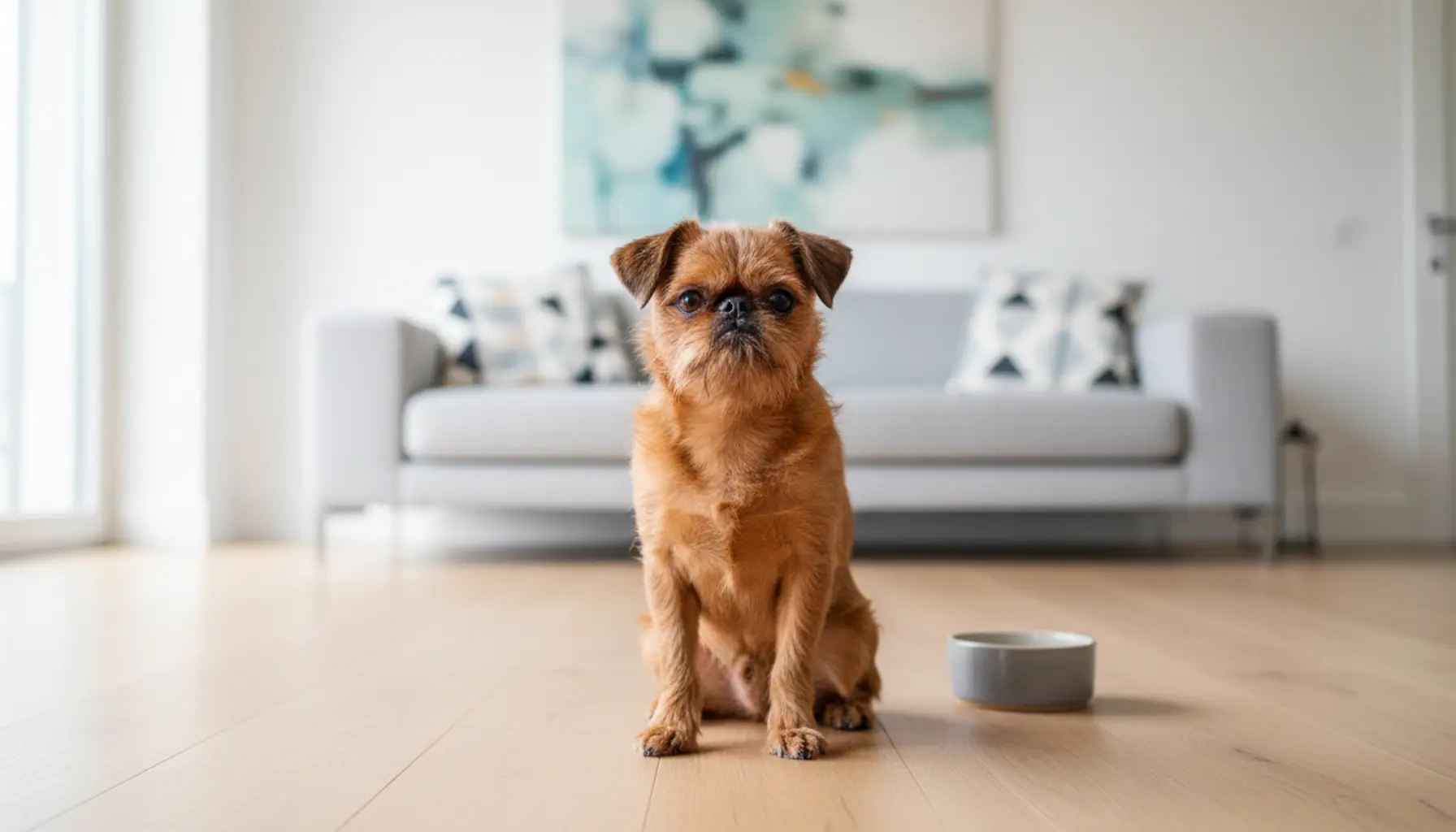
The Belgian Griffon is a dog endowed with an extraordinary personality and a unique appearance. This small breed delights with its devotion and intelligence, making the Belgian Griffon an ideal loyal companion for both families and single persons. Discover the essential information about the history, appearance, character, and daily care of this remarkable breed.
Table of Contents
- History of the Belgian Griffon
- Belgian Griffon Appearance Features
- Character and Temperament of the Griffon
- Nutrition and Grooming
- Breed Pros and Cons
- The Griffon in Your Home: The Ideal Companion
History of the Belgian Griffon
The history of the Belgian Griffon dates back several centuries and is closely related to the development of small working dogs in the area of present-day Belgium. The ancestors of Griffons were mainly small stable terriers, collectively known as “smousje” – rough-haired little dogs whose primary task was to exterminate rats and other rodents in stables, craft workshops, and marketplaces of Brussels and its neighboring cities. These dogs were exceptionally alert, lively, and intelligent, but rather rustic and utilitarian in appearance. Over time, as the urban middle class grew wealthier in the 19th century, there arose a demand for small companion dogs that combined the practical advantages of stable “rat-catchers” with a more refined look and a gentler temperament, suitable for living in salons. It was precisely during this period that Belgian breeders started the planned selection and crossing of stable dogs with other breeds—including Cavalier King Charles Spaniels, Pugs, and presumably small Pinschers and other local rough-haired varieties. The Spaniel blood contributed to the future Griffons’ expressive, large head, dark, round eyes, and a more sociable character, while the influence of Pugs is evident in the shortened muzzle, the characteristic, somewhat “monkey-like” facial expression, and a more compact build. This developmental stage was key to creating a distinct type of dog that stopped being just a stable worker and became a full-fledged, fashionable lap dog, eagerly chosen by the Belgian aristocracy and wealthy townspeople. Historical sources mention such dogs as early as the 18th century, but it was the second half of the 19th century that saw intense, purposeful breeding aimed at unifying the appearance and character traits. Brussels became a kind of center for the development of this group of small Griffons, and their likenesses started appearing in paintings, engravings, and social descriptions, further cementing their position as fashionable and desirable dogs.
With the growing popularity of companion dogs throughout Europe, Belgian miniature Griffons also attracted the attention of dog enthusiasts and breeders abroad. At the turn of the 19th and 20th centuries, the types and varieties were formally organized, leading to the distinction of three closely related breeds: Brussels Griffon, Belgian Griffon, and Brabancon (Petit Brabançon). The differences between them are primarily in the type and color of the coat: the Belgian Griffon has a rough and hard coat, with a rich beard and moustache, but in shades of black or black and tan, while the Brussels Griffon occurs mainly in shades of red, and Brabancon is smooth-coated. The standardization process covered not only external appearance but also desired character traits—selecting bold, sociable, and emotionally close-to-human dogs, but without the excessive aggression of some former stable dogs. The Belgian kennel club and subsequently the Fédération Cynologique Internationale (FCI) developed standards that became the basis for modern breeding and classification of Griffons. The breed’s position was greatly strengthened by the interest they aroused at royal courts and among the upper classes—they were gifted among noble families, traveled with their owners across Europe, and their presence in the salons of London, Paris, or Berlin helped rapidly spread their fame. The 20th century, however, brought serious challenges—both World Wars drastically reduced population numbers, and in some regions the breed almost disappeared, necessitating postwar rebuilding from a limited gene pool. Thanks to the determination of Belgian and international breeders, it was possible to preserve three separate varieties, although the Belgian Griffon—with its dark coloration and less “flashy” appearance compared to the red Brussels Griffon—remained overshadowed by its more famous cousin for many years. Only the second half of the 20th century and the early 21st century saw a gradual rise in interest in this variant, particularly among lovers of rare breeds and dogs with expressive personalities. Today, the Belgian Griffon is recognized worldwide as a companion breed, with a clear FCI standard, and its history—from modest stable “ratler,” through aristocratic favorite, to beloved family dog—serves as an interesting example of how changing human needs and tastes shape dog breed development. Although still numerically a rare breed, it enjoys a stable position in Belgium and other European countries, and conscious, responsible breeding aims to maintain both its characteristic look and the unique, lively temperament that has distinguished these small but energetic dogs for centuries.
Belgian Griffon Appearance Features
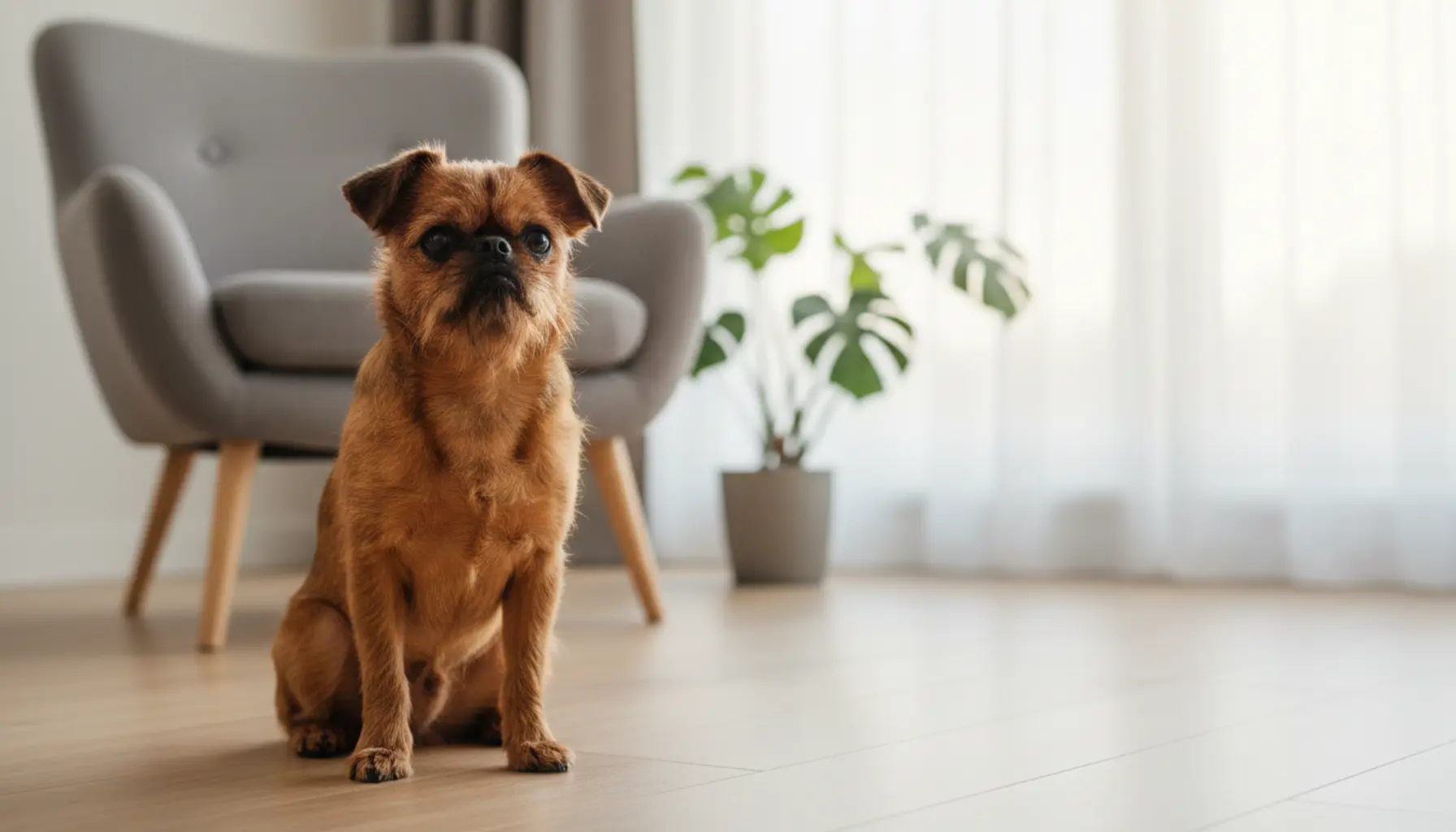
The Belgian Griffon is a small dog with an exceptionally expressive, almost “human” facial expression, which immediately catches the eye. Classified as one of the small breeds, its height at the withers generally ranges from 18–20 cm, and body weight amounts to about 3.5–6 kg, with the silhouette being compact, stocky, but not overweight. The body is nearly square, meaning that the length from the withers to the base of the tail is about equal to the height at the withers, which gives the dog a harmonious and proportionate look. The chest is well developed and reaches the elbows, lending the dog a solid but elegant appearance. The back is straight and strong, and the loins slightly arched and muscular. The forelimbs are straight, set parallel, with well-angled shoulder blades, while the hind legs are muscular with clearly marked hock joints, promoting springy, energetic movement. The Belgian Griffon’s head is one of the breed’s most distinctive features—large compared to the rest of the body, round, with a short, broad muzzle and a strongly marked stop. The muzzle is short but should not be excessively flattened; balance between the charming “flat” profile and the ability to breathe freely is essential. Characteristic is the gentle brachycephaly—the nose is short and slightly upturned, with well-opened nostrils, distinguishing the Griffon from extremely flat-faced breeds. The eyes are large, round, dark, very expressive, set quite widely apart, without bulging; their “mink-like” expression is often compared to that of a little monkey or a tiny human. The ears are relatively small, set high, carried semi-erect or slightly folded, and in their natural form give the head a soft, charming appearance. In many countries, ear and tail cropping is prohibited, so nowadays Belgian Griffons increasingly feature naturally carried, medium-length tails—set high and raised, but not curled over the back, forming an elegant extension of the body line.
The Belgian Griffon’s coat is rough, dense, and harsh to the touch, giving the effect of a “ruffled,” yet well-groomed little dog. Unlike the smooth-coated Brabancon, the Belgian Griffon sports a harsh coat, with a full beard, moustache, and bushy eyebrows that emphasize facial expression. The guard hair should be distinctly rough, never woolly or soft like in longhaired breeds—it is this correct texture that preserves the classic “Griffon” appearance. The undercoat is thick and protects against both cold and overheating, yet with proper grooming the dog does not look heavy or “puffed up.” The body hair is medium length, while the facial and muzzle hair is longer, forming a fuller beard and whiskers. The breed standard for the Belgian Griffon requires the coat to be black with possible russet, fawn, or grey tan markings, usually seen on the limbs, chest, around the eyes, and under the tail. The markings should be clearly defined and even, adding further elegance. Solid black dogs are rarer and less desired within this variety; if conspicuous brown or red areas occur, the dog may be classified as another type of Griffon. The skin should be tight-fitting, without folds that could lead to irritation. The movement of the Belgian Griffon is lively and springy, with a good stride and clear use of the hind limbs—the dog moves confidently but not stiffly, giving the impression of a small but very agile and energetic companion. The overall silhouette should give the impression of elegance and harmony, never heaviness or fragility. When judging appearance, great emphasis is placed on overall proportionality, coat structure, and the typical, expressive head, as it is precisely these elements that define whether a dog aligns with the classical image of the Belgian Griffon that so enchants lovers of the breed.
Character and Temperament of the Griffon
The Belgian Griffon is a dog that hides a wealth of emotion, energy, and attachment to humans within its small frame. It is a quintessential companion dog oriented toward close contact with its caregiver and family, and its happiness largely depends on being able to spend time with people. It’s often called a “velcro dog”—it likes to be at the center of events, watches every step of its humans, and actively participates in daily life, whether it’s resting on the couch or during short trips. The Griffon copes poorly with prolonged loneliness; it may become anxious, vocal or develop compulsive behaviors, so this breed is recommended especially to people who can dedicate a lot of attention or work from home. At the same time, the Griffon is not typically a noisy, hysterical dog—with proper socialization it usually remains emotionally stable, though it is sensitive to tone of voice and tense atmosphere. Noted for its high emotional intelligence, the Griffon quickly “reads” human moods and can adapt its behavior, becoming at times a calm companion and at others a lively playmate. In family relationships the Griffon is usually affectionate, loyal, and devoted, focusing closely on one favorite person with whom it forms a particularly strong bond, though this doesn’t mean it dislikes other members of the household.
The Griffon’s temperament blends the liveliness of a small stable terrier with the gentleness of a companion dog. It’s lively, inquisitive, and active, but not hyperactive—with enough walks and mental stimulation, it can behave calmly at home and not become a nuisance. It still has some working dog instincts, so it loves to explore its surroundings, sniff around, trail small scents, and engage in solving simple “tasks,” like treat searching or interactive toys. Belgian Griffons can be sensitive to stimuli—they react to unusual sounds or movement around them—but they usually respond with curiosity or mild alertness rather than panic. If properly socialized from puppyhood, they can become balanced, confident dogs, though compared to some breeds, they may be more delicate mentally. By nature, the Griffon is generally friendly towards humans, often open to guests, as long as the approach isn’t too pushy. With children, it’s mostly affectionate and gentle, but due to its small size and emotional sensitivity, it’s important to teach children to be gentle and respectful towards the dog. With other dogs, the Griffon can be confident and lively, sometimes unaware of its size, which may provoke conflicts with bigger, dominant individuals if appropriate guidance and dog communication training are lacking. Usually, though, its sociable nature helps it function in groups, especially if it meets various dogs from a young age. High intelligence combined with a desire to cooperate means the Belgian Griffon excels in training based on positive methods. It quickly learns commands, agility drills, or simple tricks, enjoys activities that engage the mind—rally-o, nosework, basic recreational agility, or amateur obedience. At the same time, it can be a little stubborn and independent-minded, so consistent but gentle upbringing is crucial—never shouting or physical punishments, which can cause the Griffon stress, withdrawal, or excessive excitement. Its small size doesn’t mean it’s a “toy”—the Griffon requires as much upbringing as large breeds, with consistent rule-setting, teaching to stay alone calmly, and socialization with people, sounds, and different environments. Properly managed, it turns into a dog with immense personal charm: cheerful, friendly, sociable, but also surprisingly empathetic and devoted. The character of the Belgian Griffon makes it an ideal companion for those seeking a close relationship with a dog—one who will follow daily life like a little shadow and eagerly take on new challenges and activities matched to its physical abilities.
Nutrition and Grooming
Despite its small size, the Belgian Griffon has relatively high dietary requirements, as it’s a lively, energetic, and sensitive dog. Key to proper nutrition is choosing food suited to age, activity level, and possible health concerns. For puppies, especially important is “puppy” or “junior” food for small breeds, rich in high-quality animal protein and properly balanced fats and minerals to support bone and joint development. Adult Griffons do well on “adult mini” food, which delivers concentrated energy in a small portion—important for their small stomachs. Attention should be paid to the food’s composition: meat or fish should be high on the list, and the amount of grains, artificial preservatives, and colorants should be limited. Due to small breeds’ tendency toward dental issues and obesity, it’s common to feed several small meals per day instead of a single large meal, stabilizing blood sugar and reducing the risk of overeating. Griffons can be picky eaters, so for some, mixing dry and wet food or using home-cooked meals or BARF diets under veterinary nutritionist supervision works well. Caution should be exercised when self-preparing meals, as improper protein, fat, calcium, and phosphorus ratios can lead to serious deficiencies or organ overload. It’s best to avoid common human snacks—especially candy, deli meats, seasoned foods, onions, garlic, or chocolate—as these are harmful or even toxic to the dog. Due to the relatively sensitive liver and pancreas of small breeds, Griffons should not be fed very fatty treats or have rapid food changes; any diet change should be phased in gradually over 7–10 days. Continuous access to fresh, clean water is also crucial, especially in summer or when feeding dry food. Weight control is very important—obesity strains the joints, spine, and cardiovascular system of this tiny dog, so caloric intake should match its real activity level, and training treats should be subtracted from its daily food portion. For those with skin allergies or gastrointestinal issues, mono-protein, grain-free, or veterinary prescription foods often work, but these should be selected after consulting a veterinarian, not just following trends or commercials. Periodic blood tests and at least annual veterinary check-ups will help quickly detect any dietary deficiencies, organ dysfunctions, or early diet-related diseases. Proper nutrition supports not just the Griffon’s physical condition but also its mood, coat quality, immunity, and emotional stability—dogs on a well-balanced diet are generally calmer, more focused, and easier to teach new commands.
Grooming the Belgian Griffon focuses on proper care for the rough coat, sensitive skin, and characteristic head with abundant hair. The coat consists of a hard guard coat and dense undercoat, requiring regular brushing—at least 2–3 times a week—to prevent matting, especially around the beard, ears, armpits, and groin. For this breed, stripping—the manual removal of dead hair—every 2–3 months is recommended; this keeps the coat rough, tight, unmatted, and provides better skin protection. Clipping with clippers softens the coat, may cause skin irritation and loss of typical appearance, so for show dogs and those whose classic “rough” look we want to maintain, it’s better to use a groomer experienced with Griffons. Baths are needed every few weeks or when very dirty, using mild shampoos for rough-coated dogs, avoiding harsh detergents that could dry the skin. The distinctive beard and hair around the eyes require frequent cleaning—ideally with a damp, soft cloth—to remove food, saliva, and discharge, preventing staining, unpleasant odor, and local inflammation. Important grooming elements include the eyes and ears: the Griffon’s large, expressive eyes are prone to irritation, so it’s worth checking daily for redness, excessive tearing, or discharge, and if necessary, cleaning with a recommended ophthalmic solution. Ears should be regularly checked for wax build-up, redness, or bad odor—signs of possible infection—and cleaned gently with an ear hygiene preparation, never using cotton swabs. Small breeds, including the Belgian Griffon, tend to dental tartar, so daily or at least several-times weekly brushing with special dog toothpaste greatly reduces periodontal disease risk, tooth loss, and systemic complications. For some dogs, dental chews and specialized dental foods may help, but they don’t replace mechanical cleaning. The Griffon’s nails, especially if living mostly indoors and walking on soft ground, usually need trimming every 3–4 weeks to prevent overgrowth, discomfort, or toe deformities. Regular grooming should go hand in hand with preventive health care—vaccinations, deworming, tick protection, and checkups at the vet—as well as behavioral grooming: getting the dog used from puppyhood to touch, brushing, teeth, ear, and paw inspections. Thanks to this, the Belgian Griffon, naturally sensitive and emotionally delicate, will better tolerate grooming procedures, visits to the vet’s office or groomer’s salon, and daily care will become easier and more comfortable for the owner.
Breed Pros and Cons
The Belgian Griffon is a breed that can enchant from the very first encounter, but like any dog, it has both strong advantages and limitations that future owners should know. The greatest strengths of the breed include an extremely close human bond—this is a truly “lap dog” who accompanies its owner in daily activities, is affectionate, sensitive, and very attached to its family. This strong bond fosters deep relationships and makes the Griffon ideal as a companion for single people, seniors, or families who spend a lot of time at home. Another advantage is high intelligence and trainability: Griffons quickly pick up on human cues, respond well to positive reinforcement, and enthusiastically learn tricks and basic obedience. Properly handled, they can excel in dog sports adapted to their size, such as nosework or mini agility. Many people will appreciate the compact size—small weight and height facilitate daily care, traveling, using public transport, or staying at pet-friendly hotels; yet the Griffon, despite its small build, is generally lively, brave, and energetic, not seeming like a fragile “toy.” Notably, the breed requires relatively little exercise: it needs regular walks, play, and mental stimulation but isn’t a long-distance runner, so it suits people with moderate activity levels, city dwellers, or those in smaller apartments. The breed’s specific “human-like” facial expression and rough, slightly tousled coat grant the Griffon a distinctive, charismatic appearance—it’s a dog that draws attention and easily becomes the “mascot” of an entire neighborhood. Another undoubted advantage is that a properly socialized Griffon usually gets along well with children (especially older ones who respect its boundaries) and other pets in the house, including dogs and cats, which creates good conditions for family households. Also worth mentioning is relatively minimal shedding compared to many other breeds—with systematic stripping, dead hair is removed in a controlled way, which may be beneficial for those who value a tidy home (though it does not eliminate fur and allergens completely).
Strong points, however, come with certain challenges that for some people may prove significant disadvantages. Very close attachment to the owner, while an advantage relationship-wise, can turn into separation anxiety if the dog is not taught to stay alone calmly from puppyhood; the Griffon often does not cope well with long hours of solitude, may vocalize, destroy items, or get overly stressed, so it is not ideal for those working long hours away from home. Its emotional sensitivity, so valuable with gentle humans, likewise means that the Griffon does poorly with shouting, punishment, or household chaos—improper treatment quickly affects its behavior, leading to fearfulness, anxiety, or behavioral problems. Nor is this a set-and-forget breed; in spite of its small size, it can be stubborn, try to get its own way, and with other dogs may have a “big ego in a tiniest body,” requiring consistent but gentle training and conscious socialization to prevent conflicts, especially with larger canines. Also, regular, fairly precise grooming is required—the rough coat needs systematic stripping (by hand or a professional groomer), brushing, and skin checks, while the characteristic facial structure and large eyes make some individuals susceptible to irritation, conjunctivitis, or dental issues; this entails extra effort and potential veterinary costs. Like many small brachycephalic breeds, the Griffon can be sensitive to extreme temperatures, especially heat, and to intense exercise in adverse weather, making it important to plan activities reasonably. Disadvantageous for some is also the breed’s limited availability—in many countries and regions, the Belgian Griffon is rare, meaning few breeders, waiting lists for puppies, higher prices, and the need to carefully screen breeders for health tests and responsible selection. Finally, although this breed can get along with children, it’s not a typical “all-purpose” dog: it requires a conscious home willing to devote time for close contact, training, and grooming; otherwise, its delicate psyche and unique “big personality” may become a source of frustration both for the owner and the dog itself.
The Griffon in Your Home: The Ideal Companion
The Belgian Griffon, despite its small size, quickly becomes a fully-fledged family member and usually chooses one “most important” person with whom it forms an especially strong bond. This is a dog who wants to be wherever its people are—on the couch, at the desk, in the kitchen, or even the bathroom—so it thrives best in a home where someone is there every day and can devote it attention. The ideal environment is an apartment or home of moderate size; the Griffon doesn’t need a big yard, but does need family members ready for shared activities and close physical contact. It adapts very well to city life, as long as it gets regular but not fatiguing walks and opportunities to explore new places and smells. Being emotionally sensitive, it reacts badly to chaos, shouting, and frequent changes—a calm, predictable home lets it blossom into a joyful, cheerful companion every day. With children, the Griffon is usually gentle and eager to play, but due to its low body weight, young children must be taught to handle the dog gently, never lifting forcibly or pulling its beard and whiskers. In large families, the Griffon feels good if it has a quiet retreat—a soft bed in a quiet corner where no one bothers it while it rests. It usually gets along well with other dogs, but can be confident and occasionally “forgets” its size, so interactions with much larger dogs should be supervised, especially in the early months.
For seniors, home workers, or singles, the Griffon can be an almost perfect companion: it doesn’t require extreme exercise, but greatly needs human company and daily routine around walking, playing, and calm time on the couch. It copes well with moderate activity, such as several short outings a day, leisurely park strolls, or simple home games like searching for treats in a sniff mat or learning easy tricks. At the same time, it is not a typical “couch potato” lacking energy—with the right guidance, it participates enthusiastically in obedience training, nosework, or simple mini agility. Due to its strong attachment to its owner, gradual acclimatization to short periods alone should be included in daily planning: leaving the dog in another room for a few minutes, providing stuffed “kong”-type toys, and avoiding emotional goodbyes and welcomes that could increase separation anxiety. The Griffon enjoys participating in everyday family routines—most individuals love to accompany their humans at the computer, nap on a blanket in the living room, watch cooking or TV programs from a lap—which is very soothing for many owners, but also requires setting clear rules on sleeping in beds, begging at the table, or getting on furniture. With other pets, such as cats or rodents, the Griffon usually manages good relations, but stepwise, supervised introduction and care for the safety of smaller pets are essential—its terrier roots may trigger chase instincts in response to fast-moving animals. In practice, a properly socialized Belgian Griffon fits perfectly into modern family life: it works both as a lap dog with a high need for affection and a little, resourceful walking companion, for trips or visits to dog-friendly cafes, provided it gets consistency, security, and attentiveness to its emotional needs from its owner.
Summary
The Belgian Griffon is a small dog breed distinguished by its energetic temperament and characteristic appearance. This dog, known for its expressive features and loyal personality, is the ideal companion for families and single persons alike. Thanks to its intelligence and eagerness to learn, Griffons are suitable for various roles, both as companion and guard dogs. Proper grooming and an adapted diet are key to their long, healthy life. With a Belgian Griffon in your home, you gain a loyal friend for life.

