
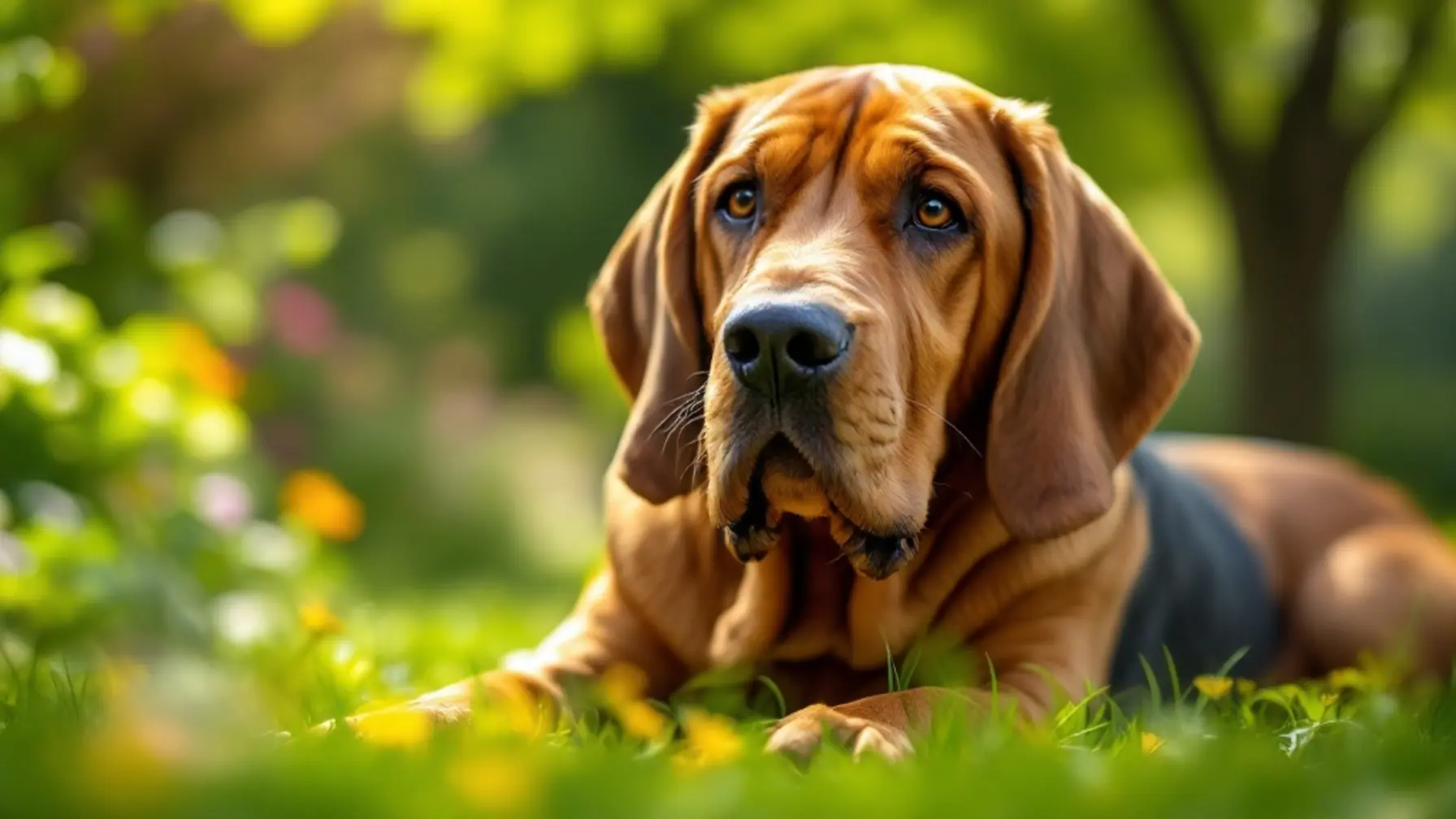
Bloodhound is a breed of scent hound, known for its excellent sense of smell and distinctive appearance. The Bloodhound stands out with its impressive body structure, characteristic skin folds, and gentle disposition. The Bloodhound is irreplaceable as a tracker, and its history and traits make it a unique working dog.
Table of Contents
- History and Origin of the Bloodhound Breed
- Bloodhound Appearance Characteristics
- Bloodhound’s Unique Scent and Uses
- Bloodhound Temperament and Behavior
- Bloodhound Health and Common Diseases
- Bloodhound Grooming and Requirements
History and Origin of the Bloodhound Breed
The roots of the Bloodhound breed reach deep into the Middle Ages, with many sources indicating that its ancestors appeared as early as the Carolingian era in what is now Belgium and northern France. It is believed that the Bloodhound descends directly from ancient scent hounds known as “chien de Saint-Hubert”, bred by monks from the Abbey of St. Hubert in the Ardennes. It was there, in the harsh forest landscape, that the monks sought a dog with an exceptionally strong sense of smell and stamina, capable of tracking game for many hours or even days. The name “Bloodhound” is often wrongly associated with “blood” in the sense of aggression, whereas in English, “blooded hound” once meant a “well-bred” or “pure-blooded” dog, referring to a carefully managed, noble breeding line. In medieval and Renaissance Europe, such dogs were highly valued at royal courts and among the aristocracy as indispensable aides in hunting big game—deer, boar, or wolves. However, their role was not limited to hunting: very early accounts mention the use of the Bloodhound’s impressive sense of smell to find missing persons or criminals, which in later centuries became the defining feature of the breed. The development of the Bloodhound was also influenced by other hounds from today’s France and the UK, including heavy Saint Hubert hounds and local tracking dog varieties. The blend of different breeding lines meant that the Bloodhound, which formed as a separate breed, combined a powerful physique with extraordinary delicacy in receiving scent stimuli. The arrival of Bloodhounds in the British Isles marked a turning point for the breed—many cynologists believe that it was in England where the modern type was ultimately established. British breeders, fascinated by these dogs’ abilities, began systematic selection in the 19th century, strengthening especially advanced scenting abilities and a calm, balanced temperament. During this period, Bloodhounds gained fame in the United States, where they were used on a large scale to track humans—the missing, escaped inmates, or criminals. Their effectiveness was so great that they became a permanent part of American law enforcement history and simultaneously were surrounded by legends, later solidified in popular culture.
The formal recognition and standardization of the Bloodhound breed progressed gradually with the development of modern cynology. In 1885, the American Kennel Club listed the Bloodhound as a recognized breed, which strengthened its position in the United States as a specialist tracking dog with exceptional utility value. In Europe, the breed’s inclusion in the Fédération Cynologique Internationale (FCI) registry was significant, where the Bloodhound was assigned to Group VI – “Scent Hounds and Related Breeds,” in the “Large Hounds” section. The establishment of an official standard allowed for a relative unification of the type, while preserving the characteristic features: loose, wrinkled skin, long ears, and impressive, drooping flews, which—importantly—also play a role in scent work by helping collect scent from the ground. From the point of view of utility history, the Bloodhound underwent an interesting evolution: from a hunting dog to a highly specialized human tracker. In the 20th century, many police and rescue units in Europe and America used (and still use) Bloodhounds to search for missing children, elderly people, or disaster victims, as well as to assist in tracking down perpetrators of crimes. In numerous court cases, a trail indicated by a Bloodhound was important evidence, further building the breed’s reputation as an “infallible nose.” Historically, Bloodhounds also became heroes in the press and police records—with detailed accounts of their spectacular successes, such as tracing after many hours or following a track across a river or crowded city. At the same time, for a long time, the Bloodhound was a relatively rare breed in Europe, associated more with specialized kennels and services than with typical family dogs. The development of modern training methods and greater awareness of this breed’s needs (including the necessity of providing adequate scent tasks) have meant that in recent decades, interest in Bloodhounds as dogs for mantrailing and scent work has grown. Nevertheless, the breed remains elite and specific, with a deeply rooted centuries-long tradition of utility. Today’s Bloodhound, although often seen at shows and in family homes, remains above all a living heir of the medieval Saint Hubert hounds—a dog whose history and origin are inextricably linked with its extraordinary ability to track human scent on a scale unmatched by other breeds.
Bloodhound Appearance Characteristics
The Bloodhound is a dog with an impressive, instantly recognizable silhouette, combining massiveness with the elegance typical of scent hound breeds. It is a large, heavily built dog, with a distinctly elongated, proportionate head and deep chest, giving it the look of an enduring long-distance runner. Adult males typically reach 64–72 cm at the withers, and females 58–66 cm, weighing about 46–54 kg for males and 40–48 kg for females, although individuals from good working lines may be somewhat lighter, maintaining a sporty condition. The Bloodhound’s body is rectangular—the body length from withers to the base of the tail exceeds its height, but it does not appear clumsy; the firm, well-muscled body, strong back, and marked loins indicate its ability to track for many hours. Limbs are strong, bony, set straight, with clearly angulated hock joints, ensuring efficient, effective movement. The paws are large, compact, with thick pads, adapted for work on diverse terrains—from forest paths to rocky slopes. The Bloodhound’s tail is set high, thick at the base, and gradually narrowing towards the tip, carried in a slight arch, never curled over the back—in motion it acts as a kind of “signal mast,” making it easier to spot the dog in dense vegetation. The overall silhouette should give the impression of harmony, proportion, and above all functionality—every element is meant to support the endurance and extraordinary tracking abilities of this breed.
The most distinguishing feature of the Bloodhound’s appearance is its head and skin—these are what set the breed apart from all other scent hounds. The head is long, narrow, with a clearly marked occipital protuberance, giving the profile a typical, somewhat “sculpted” appearance. The forehead is narrow, gently arched, with a distinct but not too deep frontal groove. The skin on the head and neck is very loose, forming characteristic folds, especially on the cheeks, under the throat, and on the neck—the pendulous dewlap (known as the “dewlap”) is one of the most recognizable signs of the breed. The skin folds align in a way that, during scent work, helps “catch” and retain scent particles, enhancing the dog’s olfactory experience. Bloodhound ears are exceptionally long, thin, soft to the touch, and set low, at the level of the eyes or even lower; at rest, they droop gently, hugging the cheeks, visually lengthening the head. The eyes are medium-sized, deep-set, with a gentle, slightly melancholy expression; their color ranges from dark brown to hazel, depending on the coat color, and the slightly drooping lower eyelids often reveal part of the third eyelid, giving a characteristic “sad” facial expression. The muzzle is long, straight or slightly arched, with a broad, large nose leather in black or dark brown; the nostrils are wide open, crucial for scent work. The coat is short, dense, closely fitting to the body, with a relatively coarse texture on the back and a more delicate one on the head and ears. The coat’s purpose is to protect against variable weather conditions, so the hairs are resistant to rain and wind, though not as insulating as in typically northern breeds. Regarding coat color, Bloodhounds are most often seen in black and tan or liver (brown) and tan, with tan shades ranging from light red to deep chestnut; solid red-fawn dogs also occur, sometimes with small white markings on the chest, paws, or tail tip, which are accepted by the breed standard. The skin, especially on the neck, chest, and limbs, remains quite loose on the torso, though it should not form excessive folds that could limit movement. The look is completed by a powerful yet elegant neck flowing harmoniously into well-muscled shoulders, and a clearly delineated rib line, giving the dog the look of an athlete rather than a heavy molossus. As a result, the Bloodhound appears as a dog of very specific, “ascetic” beauty, which for many breed lovers is a synonym for nobility and the functional biology underlying its extraordinary tracking talent.
Bloodhound’s Unique Scent and Uses
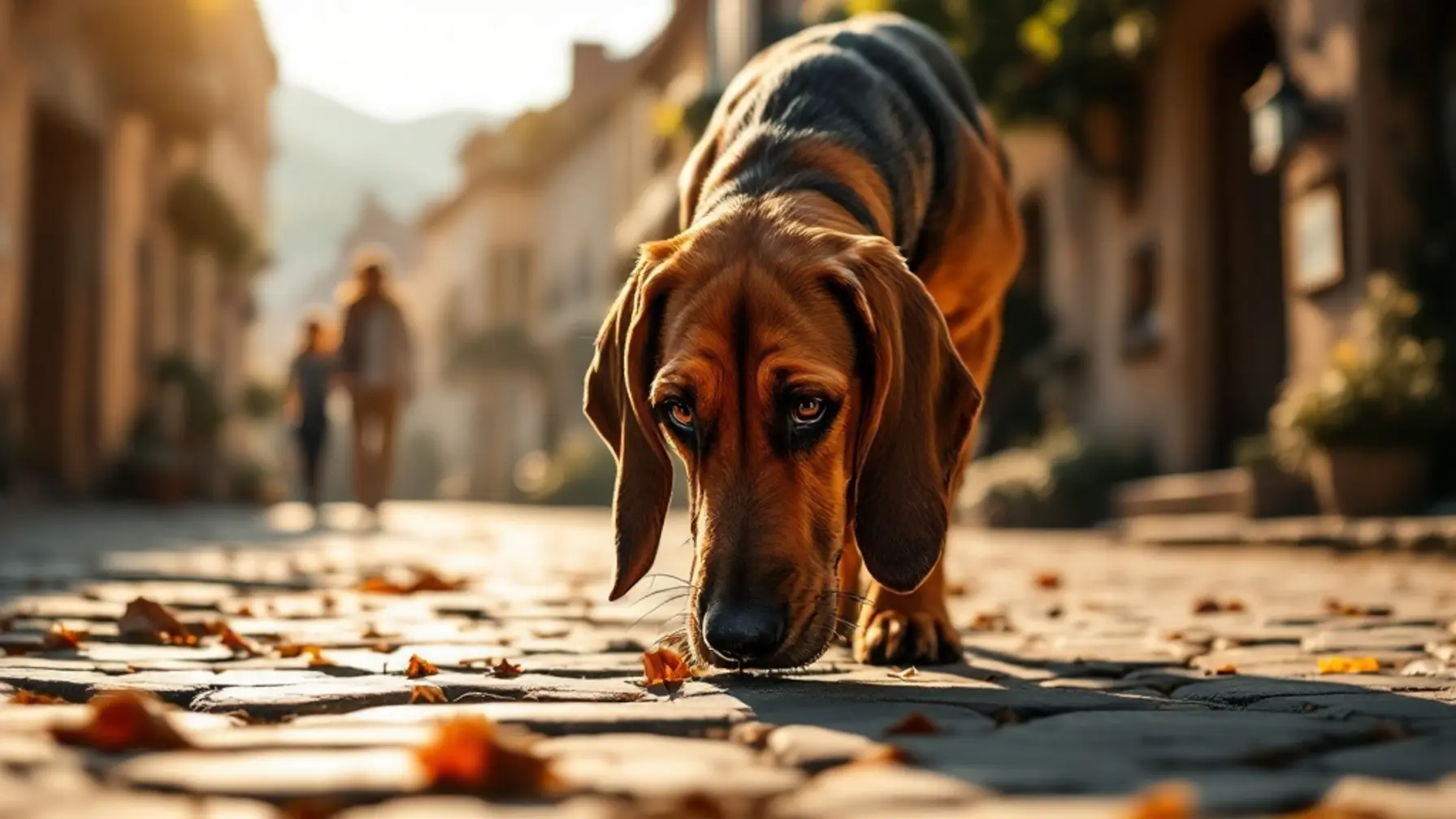
The Bloodhound’s reputation as having an “infallible nose” is no exaggeration—it is the result of both an extremely developed scent system and centuries of deliberate selective breeding. It is estimated that the Bloodhound has several times more olfactory receptors than a human, with the number reaching over 300 million, which, combined with a large surface area of olfactory epithelium, allows it to distinguish odors at minimal concentrations and extract a single scent from a background of many other aromas. The characteristic loose skin on the head, folds on the muzzle, and pronounced dewlap create a sort of “chimney” that retains scent particles near the nose, lengthening the analysis time. The Bloodhound’s long, low-set ears, while working close to the ground, sweep the substrate and lift microscopic scent particles towards the nostrils, amplifying the track collection effect. This breed has also developed a specific working style—the Bloodhound tracks with its nose close to the ground, step by step “reading” every fragment of substrate, allowing it to maintain precision even where the trail is very old, interrupted, or disturbed by other smells such as exhaust fumes, animal or human scents. What’s unique is that the Bloodhound can follow the individual scent of a particular person, based on the so-called “scent trail” (from epidermal cells, sweat, and other body secretions), meaning it does not track “any human,” but exactly the person whose scent it was presented with at the beginning of the task. In practice, the breed can maintain a trail even after many hours, and in favorable conditions—even several days after the trail was left, regardless of the time of day or weather; rain and humidity may even sometimes help maintain the scent on vegetation and soil.
The Bloodhound’s exceptional scent is widely used by law enforcement, rescue, and specialized civilian fields. In many countries, Bloodhounds are used by the police and gendarmerie to search for missing persons, track fugitives, and identify the route taken by a specific person—for example, a kidnapping victim or missing child. The dog receives a scent sample (it can be clothing, bedding, a hat, or another personal item), memorizes this scent profile, and then checks the indicated area to find the point where the person left their trail and to take up tracking. Unlike many other working breeds, the Bloodhound works mainly on so-called mantrailing—tracking the scent of a specific person in urban or mixed areas, often in the presence of numerous stimuli, cars, people, and animals. In many legal systems, the effects of Bloodhound work—especially in Anglo-Saxon countries—have been considered as supporting evidence in legal proceedings due to their high effectiveness and documented successes in finding the missing and confirming the routes taken by suspects. At the same time, despite its scenting power, the Bloodhound requires appropriate training to utilize its full potential—working with this breed requires patience, proper motivation (usually via play or food rewards), and the ability to read the subtle signals sent by the dog while tracking, such as changes in pace, direction, or head carriage. In the hands of an experienced handler, the Bloodhound becomes an irreplaceable partner in field searches, rescue operations in forests, mountains, or wetlands. Alongside professional services, there is also an amateur trend—sport mantrailing—where Bloodhound owners use the breed’s natural predispositions to build bonds with their dogs, provide mental stimulation, and channel their energy in line with their original purpose. In this context, the Bloodhound’s unique scent is not just an anatomical curiosity, but a real working tool and a source of satisfaction for both the dog and the handler—provided the dog’s innate passion for tracking is properly guided.
Bloodhound Temperament and Behavior
The Bloodhound has an extremely complex character, combining gentleness, stubbornness, and tremendous concentration on scents. With people, it is usually calm, balanced, and friendly, with no tendency toward aggression, making it potentially a good family companion—provided the owner understands the breed’s specifics. Bloodhounds are usually very attached to their caregivers, although not necessarily demonstrative—their way of showing affection may be more subdued than in typical “lapdog” breeds. Due to its strong tracking instinct, this dog often seems to inhabit its own world of scents: at home, it may be calm, even phlegmatic, but on a walk it can instantly focus on a trail and totally ignore being called. This requires the caregiver to have a strong awareness that the Bloodhound is not the type of dog to perfectly respond to recall—its concentration on the trail is so strong that obedience takes a back seat, a result of centuries of selective breeding for independent work. In everyday situations, the Bloodhound generally has a gentle, at times somewhat melancholic disposition; it can nap for hours until it catches an interesting scent. Towards strangers, it is usually courteous but rather reserved—it is rarely pushy or overly exuberant, although a well-socialized dog may willingly accept petting from guests. This breed’s sensitive psyche means the Bloodhound does not react well to harsh or loud training: it responds better to calm, consistent approaches based on rewarding desired behaviors. A striking character trait is stubbornness—if a Bloodhound decides something, e.g., to follow a trail, it’s very hard to dissuade; this is not “disobedience” in the classic sense, but the result of extremely strong tracking drive, which has been reinforced for centuries in breeding.
With children, the Bloodhound usually displays great patience, gentleness, and a high threshold for arousal, which fosters calm coexistence with the family. However, this does not make it a “nanny dog”—due to its size and clumsiness, it may unintentionally knock over a small child or step on a foot, so interactions should always be supervised by adults. Early socialization is crucial, so the Bloodhound learns gentle contact with people and good household behaviors from the start, such as calm greetings for family members or guests. Toward other dogs, the Bloodhound is generally non-confrontational: most members of the breed have a mild, peaceful temperament, though males can be dominant toward other males, especially if not raised appropriately. A specific aspect of its behavior is vocalization—the Bloodhound has a loud, deep voice and can howl or bark loudly, especially when excited or alarmed; in urban settings, this can pose a challenge and requires training self-control and providing the dog with appropriate activities to prevent it “commenting” on every situation. The key aspect of daily life for this breed is the need for mental fatigue through scent work: a simple walk without the ability to sniff is too little, which can lead to frustration and undesirable behaviors such as persistent leash pulling, destroying objects, or escaping in search of stimuli. The Bloodhound is happiest in an environment where it can regularly use its nose—be it in professional tracking, mantrailing, or simply in simple scent games organized by its owner. At the same time, because of its strong instinct to follow a trail, it is not a breed for free running off-leash in unenclosed areas; a Bloodhound that “catches a scent” can travel a long way, completely ignoring its surroundings. At home, this dog is usually calm, sometimes even lazy, likes lying on a soft bed, and enjoys physical contact with people, although its size and copious drooling can be a challenge for those who prefer perfect cleanliness. Prospective owners must therefore accept the presence of drool on walls, floors, or furniture, a result of the structure of its flews and loose facial skin—not “bad manners,” but a natural breed trait, which, combined with its stubborn yet gentle character, requires specific tolerance and a sense of humor from the owner. In the right hands, the Bloodhound becomes an extremely loyal, calm, and at the same time fascinating companion, whose behavior and daily rituals are inextricably linked to its unique scent talents and historic purpose as a human-tracking dog.
Bloodhound Health and Common Diseases
The health of the Bloodhound is closely linked to its specific body structure—massive skeleton, deep chest, loose skin, and characteristic folds on its head and neck. This breed is generally considered hardy, but prone to specific health issues typical for large dogs and scent hounds. A well-cared-for Bloodhound usually lives 8–10 years, though older individuals are sometimes seen with good preventive care and balanced lifestyles. One of the most commonly discussed health problems is a tendency to gastric torsion (GDV), especially because of the deep, spacious chest and loose ligaments within the abdomen. Gastric torsion is a life-threatening emergency, manifested by sudden abdominal swelling, restlessness, unsuccessful attempts to vomit, and rapid deterioration. For the Bloodhound, prevention is vital: splitting daily food into several smaller meals, avoiding vigorous exercise shortly before and after eating, slowing greedy eating with special bowls, and in particularly at-risk dogs—considering prophylactic gastropexy (surgically attaching the stomach to the abdominal wall). Another serious area is orthopedic disease—above all, hip and elbow dysplasia, which, because of body mass and the rapid growth rate of young Bloodhounds, can lead to pain, lameness, limited mobility, and early degenerative changes. The key is to buy puppies only from breeders who perform X-ray tests on the breeding stock for dysplasia, as well as appropriate feeding of youngsters—avoiding overfeeding, excess protein and calcium supplements, and ensuring the puppy does not run on slippery surfaces or engage in too much strenuous, jumping activity while growing. In adult Bloodhounds, weight control is essential, since every extra kilo strains the joints and increases the risk of pain and injury.
The characteristic, abundant Bloodhound skin, which gives the breed its recognizable appearance, predisposes it to certain dermatological issues. Skin folds on the muzzle, neck, and chest provide a warm, moist environment where bacteria and yeast can thrive, leading to chronic fold dermatitis (intertrigo). Symptoms include redness, unpleasant odor, moist discharge, or itching. Prevention involves regular cleaning of the folds (e.g., with special wipes or veterinary-advised antiseptic solutions), thorough drying of the skin after bathing or walks in the rain, and monitoring for hotspots or irritation. Due to loose skin around the eyelids, Bloodhounds may suffer from entropion (rolling the eyelid inward) or ectropion (rolling the eyelid outward). Both conditions cause chronic eye irritation, tearing, recurrent conjunctivitis, and, when untreated, even corneal damage. In many cases, surgical correction of the eyelids is necessary, especially for dogs used in the field where eyes are further exposed to dust and plants. The breed is also at increased risk of ear infections because long, heavy, low-set pinnae restrict airflow to the ear canal, while close contact with the ground when tracking facilitates the introduction of dirt and microbes. Regular ear checks and cleaning with specialized ear products, drying after bathing, and a quick response to symptoms such as head shaking, scratching, unpleasant odor, or discharge are the basis for prevention. Some Bloodhounds also develop typical large breed heart diseases, including cardiomyopathies and valve disease, so it’s worth including periodic echocardiograms, especially if the dog shows exercise intolerance, coughing, or tires quickly. Because instances of inherited diseases—such as some forms of epilepsy—are recorded in the breed, owners should closely monitor any worrying neurological signs, and when buying a puppy, require information about the health of relatives from the breeder. Regardless of individual predispositions, maintaining a Bloodhound’s good condition relies on regular veterinary check-ups (including annual blood and urine tests in older dogs), timely vaccination, protection against internal and external parasites, weight monitoring, an appropriately selected diet, plus a daily dose of exercise and scent work that keeps both the body and mind of this dog healthy.
Bloodhound Grooming and Requirements
Despite its short hair, the Bloodhound is not a “low-maintenance” breed—its body structure, loose skin, folds, and long ears require consistent and thoughtful care. Fundamental is regular brushing of the short, dense coat with a rubber brush or glove with nubs to remove dead hair and debris and stimulate skin circulation; usually one–two thorough brushings per week suffice, though during shedding season it’s worth increasing the frequency. Baths should be relatively rare and performed only when needed, using mild shampoos for dogs with sensitive skin, as excessive washing removes the natural protective layer and may worsen dermatological problems that Bloodhounds tend to have. Daily attention to the skin folds—especially on the muzzle, neck, and dewlap—is key, as moisture, food residue, and dirt easily collect there; these areas should be gently wiped with a damp and then dry cloth, thoroughly dried, and watched for redness, unpleasant odor, or discharge. The breed’s long, heavy ears need regular airing and inspection—at least once a week, they must be checked, gently cleaned with canine ear cleaner, and if there is too much discharge, itching, or head shaking, a quick vet visit is needed since untreated ear infections are common and painful for Bloodhounds. Don’t neglect eye care in daily routines: due to loose eyelid skin, mild irritation and discharge may appear, which should be removed with sterile gauze moistened with boiled water or an ophthalmic preparation prescribed by the vet. Regular nail trimming is necessary because heavy Bloodhounds suffer if the nails are too long, affecting limb alignment and joint strain; if the dog does not wear them down naturally on hard surfaces, they should be trimmed every 3–4 weeks with a guillotine or nail grinder. Furthermore, this breed drools heavily, especially after drinking, eating, or when excited—so it’s good to keep a towel or cloth on hand and accept in advance that keeping the house clean will take more work, so the owner must be prepared for this already when deciding on the breed.
Bloodhound’s needs go far beyond coat care and cover lifestyle, nutrition, space, and conscious management of its psycho-physical needs. As a large, heavy dog with an exceptional sense of smell, it needs appropriate daily exercise—but not in the form of strenuous, fast running on hard surfaces, but rather longer, calm walks with opportunities for intensive scent work—at least 1.5–2 hours of activity a day, divided into several outings, including at least one high-quality walk with scent exercises. Letting a Bloodhound off-leash requires particular caution: its tracking instinct is so strong that it easily “drifts off” on a trail, ignoring commands, so either a well-fenced area must be provided, or a long line used and intensive work on recall started as early as puppyhood. Because of the risk of gastric torsion, and strain on joints, careful exercise planning around meals is necessary—the Bloodhound should not engage in vigorous exercise for an hour before and at least two hours after eating; its food should be split into 2–3 smaller servings per day, fed from a bowl at appropriate height so the dog doesn’t have to stoop. A well-balanced diet with controlled protein, fat, and calcium levels, tailored to the life stage (puppy, adult, senior) and the work performed (family dog, working scent hound) is crucial for maintaining proper body mass; overweight Bloodhounds rapidly develop orthopedic and heart problems, so regular weighing and body condition assessment are mandatory. Living conditions should provide enough space for movement, a soft, stable bed to protect the joints, and a place to rest away from drafts—the Bloodhound does not do well in isolation in a kennel, especially without family contact; yet it is also not ideal for small city apartments if the owner cannot provide truly intense scent work outdoors. Safety depends on a solid, high fence, since a Bloodhound following a trail can surprisingly easily escape from a property. Consistent but gentle upbringing based on positive reinforcement, patience, and short, motivating training sessions are essential—too harsh methods will quickly discourage this sensitive dog and impair its cooperation. In everyday life, keep in mind its loud, melodic voice: where you live, wall thickness, and relations with neighbors become tangible issues, and teaching quiet/“hush” commands should be part of basic upbringing. Only an owner ready to combine daily grooming, appropriate nutrition, regular veterinary checks, and breed-specific physical and scenting activity can give the Bloodhound conditions to thrive physically and mentally healthy.
Summary
The Bloodhound is an extraordinary breed known for its excellent sense of smell and friendly disposition. Its unique appearance and history make it exceptional among hunting dogs. Bloodhounds are gentle and get along well with children and other animals. However, due to their genetic predispositions, it’s important to monitor their health, especially joints and eyes. Grooming this breed is relatively simple but must be consistent. We encourage future owners to take a responsible approach to caring for these wonderful dogs.

