
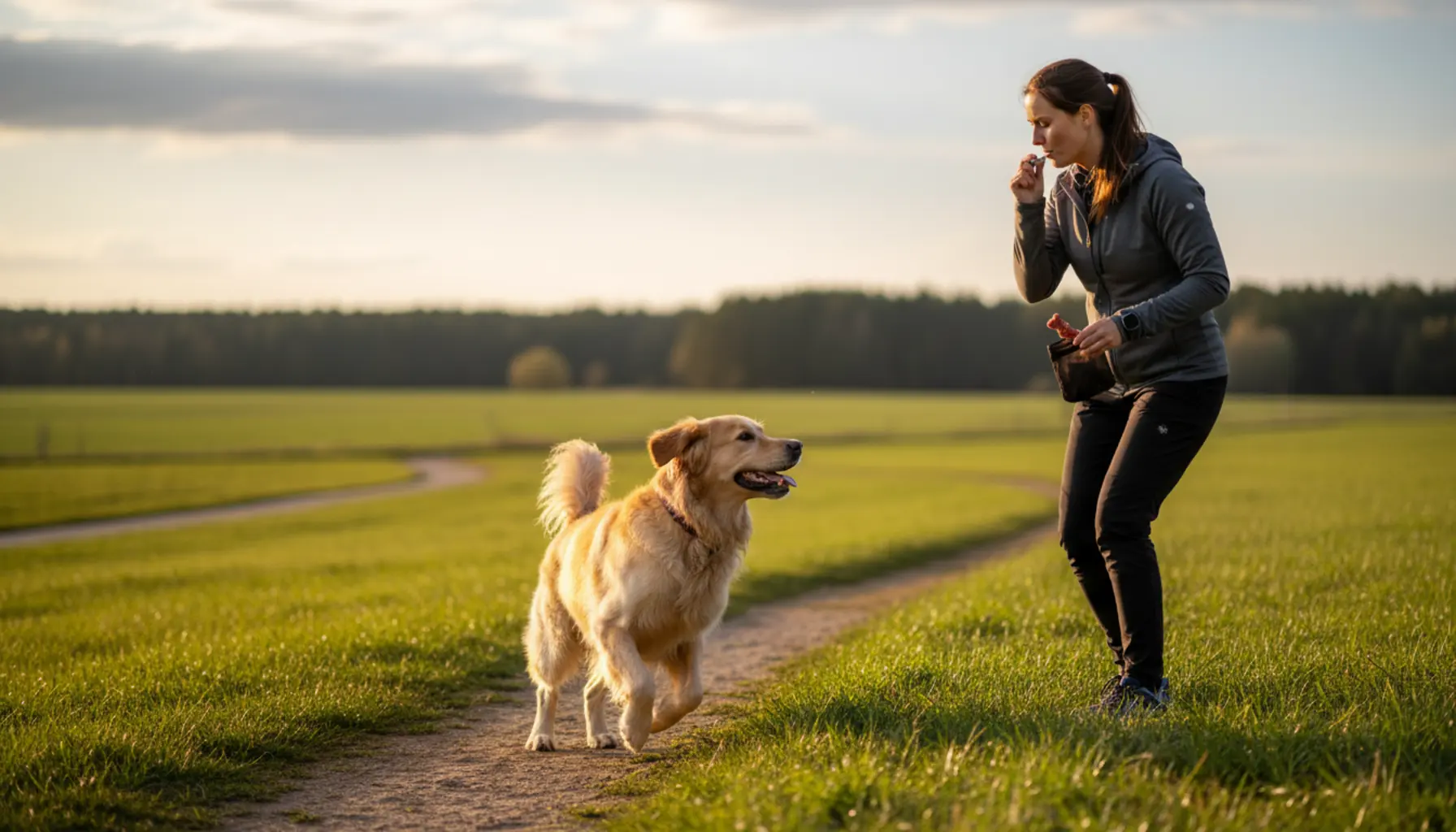
Recalling a dog with a whistle is an exceptionally effective method for building a reliable recall response, increasing safety and comfort during shared walks. Proper training using a repeatable signal allows you to achieve lasting results even in challenging conditions.
Table of contents
- What is recall and why is it important?
- Whistle for a dog – advantages and uses
- First steps in learning recall
- Recall training with a whistle – practical tips
- Common mistakes in teaching dog recall
- How to consolidate recall and increase your dog’s safety?
What is recall and why is it important?
Recall is a command by which the dog, on the handler’s signal – verbal, whistle, gesture or another chosen cue – immediately stops what it is doing, turns around and returns to the owner. In practice, “recall” is not only the return itself, but a whole chain of behaviors: the dog registers the signal, decides it is worth responding, heads toward the person, runs up and stays by them until given another command. Good recall is therefore a combination of a well-trained response and trust in the handler – the dog returns because it knows it pays off and that being near the person is safe. In the context of a whistle we speak of a special type of recall where, instead of a verbal command (e.g. “come!”), we use a short sequence of sounds that becomes an unambiguous signal for the dog: “stop everything and return as fast as possible.” For recall to be truly effective, it must work regardless of circumstances – at home, in the park, in the forest, around other dogs, in the presence of wildlife or tempting smells. From a training perspective this means that the response to the recall signal should be practiced to an almost reflexive level, so the dog returns not only when it “feels like it,” but also when it is highly aroused or absorbed by something. Achieving that level of reliability requires time, consistency and an appropriate training plan, but it forms the foundation of a mindful and safe life with a dog.
Knowing and practicing effective recall is immensely important primarily from a safety perspective. A dog that immediately comes back on a whistle can avoid running into traffic, chasing a cyclist, entering private property or approaching an aggressive dog; with one short signal you can prevent situations that could end in tragedy. In many countries having a dog with a reliable recall is even seen as part of responsible pet ownership – it allows you to enjoy walks with greater freedom (e.g. on a long line or off-leash where legally permitted) without excessive risk to others. From a daily comfort standpoint, recall is also a tool that reduces stress for both the owner and the dog: you don’t have to shout across the park, the dog avoids the chaos of inconsistent cues, and your communication becomes clearer. Importantly, well-established recall strengthens the human–dog relationship. The animal learns that returning to the handler is always positive: a reward, play, support, a feeling of safety. As a result the dog keeps in contact more often, checks where you are, and remains “mentally” with you on walks instead of completely tuning out and focusing only on its own activities. Recall also has legal and social dimensions – in many places regulations require that a dog be under control, which in practice means the ability to quickly and effectively call it back. For bystanders – other walkers, families with children, runners – seeing a dog that returns on a signal builds trust and reduces concerns, even if the dog is large or appears “intimidating.” Finally, from a training point of view, the whistle as a recall tool has particular advantages: it provides a repeatable, consistent sound that is easy to distinguish from other cues, carries farther than the human voice and does not betray the handler’s emotions (fatigue, anger, nervousness). For the dog it is therefore a clear, pure signal with an unambiguous meaning. That is why it is worth treating recall not as a single trick but as a key life skill for the dog that is worth carefully building and reinforcing every day.
Whistle for a dog – advantages and uses
A whistle for a dog is an apparently simple tool that can dramatically change the quality of communication with your dog, especially when working on recall. The biggest advantage of the whistle is its consistency – the sound always sounds the same, regardless of our mood, fatigue or stress level. In practice this means the signal is clearer to the dog than a voice command, which can vary in tone, volume or emotional coloring. A whistle’s sound is also more audible at greater distances than the human voice, particularly in open spaces, in strong wind, in the woods or in noisy surroundings, which translates to more effective recall in real-life situations. Additionally, the whistle does not strain the handler’s voice and prevents repeated shouting, which can be frustrating for both human and animal. Many handlers also appreciate that the whistle is a “socially neutral” signal – you don’t have to loudly call your dog’s name in the middle of a park or beach, which can be embarrassing, especially when the dog does not yet respond perfectly. It’s worth emphasizing that a whistle can be helpful when working with anxious or overly sensitive dogs – when introduced properly, its sound can be less stressful for them than raised human voices. Equally important is that a whistle allows you to differentiate cues: you can assign one meaning to a short pattern of blows and another to a longer tone, giving the handler more flexibility in communication. A well-trained dog quickly learns that a specific whistle pattern always means the same – for example, immediate return for a reward – making the command clear and predictable and increasing the dog’s willingness to cooperate.
In practice, a whistle for a dog has wide applications both on everyday walks and in more advanced training. In daily life it works great during outings in open terrain, meadows, forests or near water where the dog has more freedom and can wander off more easily. Instead of repeatedly calling the pet by name, the handler gives a short, distinct whistle signal that cuts through the wind, water splashes or sounds of other dogs. This is particularly important in potentially dangerous situations – when wildlife appears nearby, busy roads, cyclists or runners – because a quick response to the whistle can prevent problems. The whistle is also a huge help when working with hunting, herding or sporting dogs that operate at a distance from the handler; in such cases a precise, audible cue is a basis for safety and effectiveness. It is also useful in training rescue dogs, tracking dogs or those competing in sports like agility or canicross, where the dog is expected to respond quickly despite high arousal. In urban conditions a whistle can help when the dog runs on a long training line in a park with a lot going on – children, other walkers, bicycles – allowing the handler to maintain control while giving the dog freedom of movement. With skillful use, the whistle can also separate “whistle communication” from everyday voice commands, which is useful in households with multiple people – the dog then does not confuse casual calls with the trained recall signal. However, remember that a whistle itself will not make the dog come back – it is only a tool to convey a signal, and its effectiveness depends on how consistently and positively it is trained. Choosing the right whistle (classic, ultrasonic, adjustable frequency) and establishing one specific sound pattern for recall, then systematically pairing it with an attractive reward, makes the whistle a clear message to the dog: “return immediately, it pays off.” This tool works for both young dogs that are just learning the rules and older dogs that need their recall associations clarified.

First steps in learning recall
The beginning of recall training should always take place in the simplest, most favorable conditions before introducing the whistle as the final signal. At the start it is crucial to build a positive association: recall = something very pleasant happens with the handler. Therefore the first sessions are best held at home or in a calm, fenced area with no distractions like other dogs, people or strong smells. Make sure the dog is moderately hungry – not just after a meal – and prepare valuable treats (e.g. soft pieces, cooked meat, high-quality dried meat) that are clearly better than everyday kibble. At this stage the handler’s attitude is also very important: friendly tone of voice, a bent posture, encouraging gestures and no irritation, even if the dog responds slower than you’d like. The first attempts may involve calling the dog by name and immediately rewarding it verbally (“good!”, “well done!”) and with a treat as soon as it even looks in your direction or takes a step toward you. This teaches the dog that moving toward you always pays off and that you are the source of good things. At the same time avoid automatically reaching for the collar as soon as the dog approaches – initially reward it beside you, pet it, step away two steps and call again to develop a desire for spontaneous, repeated returns. It’s also worth deciding right away which final signal you will use: a verbal command (e.g. “come”) or a combination of the name with a whistle. You can start with the verbal cue and after a few days add a short whistle signal so the dog learns both mean the same thing. Consistency is important – don’t change words or the whistle pattern randomly to avoid confusion. First sessions should be very short, literally a few minutes, but repeated several times a day (e.g. 3–5 times) so recall becomes automatic rather than requiring lengthy thought from the dog.
When the dog already understands that approaching you pays off, you can gradually raise the difficulty level while still carefully adding distractions. A good step after indoor training is recalls in a garden or a calm, fenced field, initially on a long training line (e.g. 5–10 m). The line gives the dog relative freedom while allowing you to maintain physical control if it decides to run the other way. At this stage introduce a clear structure: first the dog’s name (to get attention), then the recall signal – word or whistle sound – and finally an enthusiastic reward as soon as the dog is at your feet. Reward not only the act of approaching but also quick running toward you, shortening the distance, and even an energetic glance or hesitation if the dog is still learning to give up on something in the environment. If you introduce the whistle, for the first few days do so by “pairing” the cues: give a short whistle, immediately say the verbal command, and when the dog comes – reward. After several dozen repetitions the dog begins to understand that the whistle alone also means “run to the person for a reward.” Make training fun for the dog – you can move away slightly, “run away” from the dog, crouch, clap your hands to increase the attractiveness of returning. Don’t call the dog too often just to end the walk or go inside, especially in the early training phase, because this can weaken motivation to respond. Instead call the dog a few times, reward it lavishly, then… let it go back to exploring. This gives a clear message that recall doesn’t automatically mean the end of fun but is merely a short “pause” in play or sniffing. Gradually introduce light challenges – gentle distractions, the presence of a calm dog in the distance, new places – always remembering not to make too big “jumps” in difficulty. If you see the dog stop responding, return to simpler conditions and reinforce the basic association a few times: the recall signal predicts the highest-value reward. With a gradual and thoughtful approach, the foundation of recall will be stable, and the next stage – fully transferring the command to the whistle and using it in increasingly difficult situations – will go much more smoothly.
Recall training with a whistle – practical tips
Effective recall training with a whistle should start by choosing one specific signal that will always mean the same thing: return to me immediately. Short, repeatable sequences work best, e.g. “pi–pi–pi” (three short blasts) or “piii–piii” (two longer blasts). It’s important that all household members use exactly the same pattern with the same intensity and in similar situations – changing the signal confuses the dog and prolongs learning. The first step is to build a strong association between the whistle and something exceptionally pleasant. For several days practice at home: blow the chosen signal, then immediately put the dog’s best treat under its nose without expecting any behavior. The dog should feel that the whistle reliably “announces” a reward just like the rustle of a treat bag. Only when you notice the dog immediately perking up, listening or beginning to move toward you after the whistle should you move to the next stage. During that stage start pairing the whistle with the dog’s movement toward you – blow, step back a step or two to encourage motion with your body and gestures, and when the dog takes even a few steps toward you, reward generously and let it go again. This ability to return to previous activity is important: if you always end play or the walk when you call, the dog will quickly avoid responding. At the same time pay attention to the quality of rewards – in the early stages of whistle recall training use “super treats” the dog doesn’t get every day (e.g. small pieces of cooked meat), plus vocal praise and short play if your dog enjoys it. Also keep the whistle always at hand: hanging on the leash, with your keys or around your neck so you can react instantly without searching pockets, because a delay between behavior and signal/reward reduces training effectiveness.
Another important element is introducing gradual challenges. Start indoors without distractions, and when the dog responds to the whistle nearly 100% of the time, move training to the garden or a calm fenced area using a long training line (10–15 m) that lets the dog move freely while you keep control. Allow it to move away and engage in something (sniffing, slow walking), then blow the whistle and observe the reaction. If the dog even turns its head toward you, you can initially help slightly by tightening the line and stepping away from the dog while warmly encouraging it. As soon as it reaches you – reward, release and give a moment for exploration before repeating. This teaches the dog that whistle recall doesn’t mean the end of freedom but rather a short “check-in” with the handler. Gradually increase distance and the time between recalls, keeping an element of unpredictability – sometimes the whistle is followed by a reward and return to play, other times a change of walking direction, a short trick training or throwing a ball as a “jackpot.” Avoid calling when the dog is extremely absorbed in another stimulus it cannot yet “let go” of (chasing birds, intense play with another dog); in such cases it’s better to approach and help with the line than to damage the cue with a series of ignored signals. Also ensure the whistle is never a prelude to something unpleasant – don’t call the dog with the whistle only to scold it, clip nails, force an unwanted bath or immediately put it in the car ending a great walk. If you must pair recall with a less attractive activity, follow it with an exceptional reward and a short play session so the overall experience remains positive. Consistency in using the whistle is key: don’t use it for other commands (e.g. “sit”, “down”), don’t blow it for fun and don’t let children treat it as a toy. For the dog it must be a clear, unequivocal signal that it always pays to return, so it’s better to do fewer well-thought-out repetitions than to whistle often in situations where the dog has no realistic chance of success.
Common mistakes in teaching dog recall
One of the most common mistakes in teaching recall – whether using voice or whistle – is calling the dog only when “something needs to be done” or when the situation is already difficult. Many handlers call or whistle only to attach a leash, end play, go home or interrupt an attractive activity. As a result the recall signal starts to be associated with loss of freedom rather than something pleasant and rewarding. Another common mistake is repeating the command or whistle ten times in a row when the dog does not respond – this trains the animal to ignore the first signal because the “real” command is often the later one. Another problem is calling the dog in situations where its chances of success are minimal: for example the first time off-leash in a highly distracting dog park, during intense play with other dogs, or when it has just started chasing wildlife. Repeated “empty” recalls that the dog cannot physically or emotionally respond to lead to rapid extinction of the reaction to the signal. A mistake that strongly undermines the dog’s trust is punishing it after it comes – shouting, yanking the collar, unpleasantly fastening the leash or using a harsh tone. For the dog what matters is the here and now: if after hearing the whistle it comes and then experiences anything unpleasant, it will be far less willing to respond in the future. This group of errors also includes grabbing the dog’s collar immediately after recall without first building a positive association with touch around the neck and abruptly ending all attractions the moment the dog returns instead of allowing it to go back to play or sniffing after a moment. Very often inconsistency and mixed signals are also a problem: sometimes calling by name, other times using the command “come”, and with the whistle changing its length or rhythm depending on mood. For the dog such variability is incomprehensible and makes learning the meaning of the cue difficult. Many handlers forget to consistently reinforce the command – rewards appear only at the start of training and then vanish too quickly or become predictable and less appealing. The dog quickly learns that recall is “not worth it” in everyday situations, especially when there are far more interesting stimuli around like other dogs, smells or running children. Another frequent mistake is rushing: handlers skip exercises at home and jump straight to difficult conditions, forgetting the principle of gradually increasing distractions and the work on a long line in semi-open spaces, which raises the risk of the dog escaping and reinforcing unwanted behaviors (e.g. ignoring the recall when highly aroused).
Typical pitfalls also include improper use of the whistle itself when teaching recall to that specific signal. Sometimes the handler treats the whistle like a “magic button” the dog should obey without prior deliberate work on associations. As a result the signal is not linked to a reward and its use becomes chaotic – sometimes during play, sometimes while scolding the dog, other times as a frantic call from a distance. Some change the whistle or sound pattern during training (“this one is probably easier to hear”, “I’ll try blowing differently”), which for the dog actually means introducing a completely new command it has to learn from scratch. Another mistake is “flooding” the dog with sounds: frequent whistling without meaning, for fun or out of boredom, leads to habituation – the dog gradually stops paying attention to a cue that means nothing important. It’s also worth avoiding confusing recall with driving the dog – using the whistle to speed up walking at heel, calling it from the bowl, scolding for slow responses or interrupting every activity eventually turns the whistle into a pressure signal rather than a pleasant invitation to the handler. Training recall only in one context (e.g. only in a meadow, only in the forest or only on a leash) is also an error – lack of generalization means the dog may come on cue in the familiar place but completely ignore it in a new environment, even though for the handler it is “the same command.” Underestimating the dog’s individual characteristics – age, temperament, breed predispositions – leads to growing frustration: expecting a puppy to focus like an adult dog, or a young retriever to work through distractions like a calm, older mongrel. In response the handler raises their voice, whistles more violently, speeds up movements and training turns from relationship-building into a stressor for both sides. Finally, many people do not plan recall training as a process: lack of short, frequent sessions, no progress monitoring, no conscious decision when to increase difficulty or step back results in chaotic learning and an unpredictable response that depends on “luck” instead of a stable, practiced skill.
How to consolidate recall and increase your dog’s safety?
Consolidating recall and translating it into real-life safety requires a deliberate plan, consistent practice and adapting training to changing conditions. The key is moving from simple exercises at home to situations increasingly similar to those the dog encounters in reality – on walks, in parks, in forests or in the city. In practice this means systematically increasing distractions: first exercises in the garden or a quiet meadow, then in moderately busy places, and finally in surroundings full of stimuli such as other dogs, people, wildlife scents or traffic. A long training line (10–15 m) is very useful because it allows the dog relative freedom while giving the handler the ability to physically secure the recall if the signal is ignored – this prevents the dog from learning that it can “get away” with ignoring the command. Every successful recall, even after many months of training, should be generously rewarded: an exceptionally tasty treat, play with a favorite toy, permission to continue exploring, or a short chase with a ball. Over time you can introduce a variable reward schedule so the dog cannot predict exactly what it will get – but always feels that returning to the handler pays off. To consolidate the whistle response, weave the recall signal into the daily routine: before meals, before going for a walk, when changing resting places – a short signal, the dog runs in, gets a reward or access to a resource, and the whistle becomes a “magic sound” that always announces something good. Managing the handler’s emotions is also crucial: if the dog does not react immediately, do not raise your voice, shout, threaten or chase it. Instead increase your attractiveness (crouch, turn slightly sideways, run in the opposite direction using a cheerful tone) and, if necessary, “remind” it with the training line. At a later stage, train recall in different configurations: two handlers can alternate calling the dog on the same whistle or different signals – the dog learns to return to the person who gave the cue, regardless of distance or direction. Such exercises simulate situations where the dog is far away and must decide where to run when hearing the whistle. To make recall truly reliable, periodically return to easier exercises even when the dog is doing very well – this prevents the response from becoming “fuzzy” and keeps the association that every return is beneficial.
Strengthening recall directly improves your dog’s safety, but it also requires a few additional rules to minimize risk. The basis is conscious management of freedom: a dog should not be let off the leash in a place where it cannot yet handle the level of distractions or where there is a risk of unexpected stimuli (e.g. a busy road without fencing, an area with wildlife during breeding season, near a children’s playground). Before giving full freedom, perform a “readiness test”: the dog is on a long line, the handler lets it explore briefly, then gives the whistle signal. If the dog returns immediately, eagerly and without hesitation, the chance it will respond off-leash is high; if it ignores the command, returns slowly or stops halfway, continue working on the line and do not risk letting it off. Teaching additional “emergency” behaviors such as a crisis recall (a super-strong recall used only in critical situations and always rewarded with a “jackpot” – e.g. an exceptionally tasty portion) or a “stop/wait” command at distance to halt the dog before it reaches danger is also very useful. With the whistle you can use two different sequences: one more common for standard recall and another rarer, distinct one reserved for emergencies, always followed by a massive reward. In everyday walks think preventively: rather than reacting when the dog is already running after another dog or a deer, react earlier – call, reward and briefly leash up as soon as you spot a potential trigger. This proactive approach teaches the dog that staying in contact is worthwhile even with strong temptations nearby. Also mind the “mechanical” aspects of safety: properly fitted collar or harness, an ID tag with a phone number, possibly a GPS tracker on the collar and up-to-date vaccinations and identification (microchip, tattoo). While these elements do not replace a well-established recall, they are additional safeguards if something unexpected happens. Your dog’s safety is also increased by consistency among family members – everyone should use the same signals, reward recall in the same way and respect the rules for when to let the dog off the leash and when not. This prevents contradictory messages and ensures the dog understands that the whistle or specific cue always means the same thing: a profitable, quick and safe return to its person.
Summary
Recalling a dog with a whistle is a reliable way to improve safety and communication with your pet. Using clear signals and consistent training based on positive reinforcement produces lasting results in both puppies and adult dogs. Avoiding common mistakes and consolidating the return reflex gives the handler greater control during walks and in emergency situations. Use our proven tips to make your time with your dog calm, safe and full of trust.

